Assess the circumstances that led to the formation of Andhra Pradesh.
In short
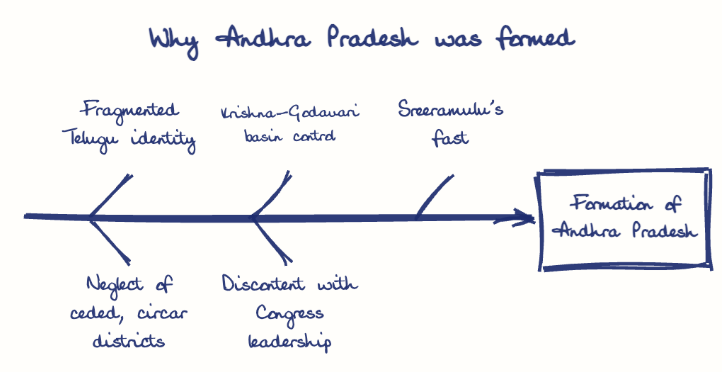
Andhra Pradesh arose from Telugu linguistic identity divided between Madras and Hyderabad, economic neglect, the logic of unified Krishna and Godavari basins, and discontent with the Madras Congress. Potti Sreeramulu's fast produced Andhra State in 1953, and political pressure and the Gentlemen's Agreement brought the 1956 merger with Telangana.
Model answer
Ghissu Editorial · Verified 4 Oct 2026 · 288 words
Linguistic and Cultural Identity
Telugu speakers under Madras Presidency and Hyderabad State demanded a unified state to protect their language and culture, championed by Andhra Mahasabha conferences that consolidated regional identity and aspirations.
Political Mobilisation and Potti Sreeramulu’s Martyrdom
Dissatisfaction with Congress leadership and the failure to address Telugu demands led to political mobilisation. Potti Sreeramulu’s 58-day fast in 1952, ending in his death, transformed the movement into a mass agitation, compelling Nehru to announce Andhra State’s formation.
Dar Commission and SRC Recommendations
The Dar Commission (1948) acknowledged linguistic demands but warned of risks of provincialism; the States Reorganisation Commission (1955) saw the economic case for merging Andhra State with Telangana, especially for river basins, but advised keeping Telangana separate until about 1961.
Merger and Name Change
Despite Telangana’s concerns over economic disparities and job opportunities, the merger proceeded under the States Reorganisation Act, 1956. The new state was named Andhra Pradesh to promote unity and avoid regional divisions.
Economic Integration and Administrative Efficiency
The merger aimed to unify resource management of Godavari and Krishna rivers, boosting agriculture and governance, and enabling focused development of Telugu-speaking regions.
Regional Disparities and Safeguards
Telangana’s fears of neglect led to the Gentlemen’s Agreement, which promised safeguards for Telangana’s interests. However, implementation issues caused political tensions and demands for greater autonomy in later years.
This model answer is indicative and the model can make mistakes; please verify key facts independently.
Practise this question
1Get the answer sheet
Sized for this question.
2Write your answer
Timed, by hand.
3Get it marked
Your score and what to fix.
This chapter in the exam
Andhra - Nationalist Movement and Formation of the State22 questions
Asked in 8 of 8 sittings since 2008
Most tested: Formation of Andhra Pradesh and the Andhra-Telangana statehood process
- 2025What were the provisions of the Gentlemen's Agreement of 1956? How far could they satisfy apprehensions of the Telangana region?
- 2025Outline the role of the students in raising major issues in the 1969 Telangana agitation.
All 22 questions, sorted by sub-topic, with model answers and practice.
Question from the official APPSC Group-I Mains 2008 paper. Answer written by Ghissu's engine and checked against our editorial standards. Found an error? Tell us and we correct it within 48 hours.