Briefly explain what are the circumstances that led to the establishment of Asafjahi dynasty and the role played by Nizam-ul-Mulk.
In short
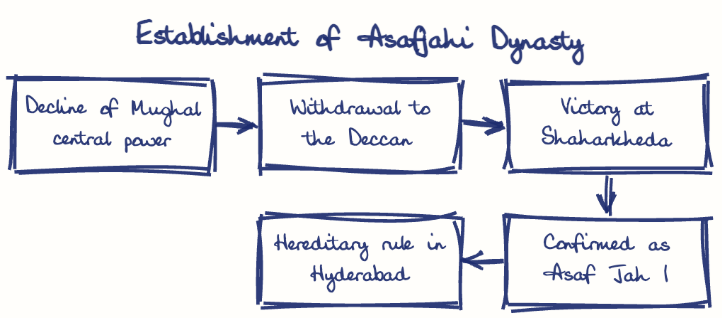
The Asafjahi dynasty arose from Mughal decline after Aurangzeb's death in 1707 and court factionalism, which drove Nizam-ul-Mulk from Delhi to the Deccan. He defeated Mubariz Khan at Shaharkheda in 1724, became Asaf Jah I, and combined nominal Mughal allegiance with real independence and Maratha diplomacy.
Model answer
Ghissu Editorial · Verified 4 Oct 2026 · 307 words
Decline of Mughal Authority
After Aurangzeb’s death, Mughal power waned, enabling provincial governors like Mubariz Khan to assert near-independence.
Nizam-ul-Mulk’s Withdrawal
Disillusioned as wazir with the intrigues of Muhammad Shah's court favourites, he left Delhi for the Deccan in 1724.
Military Conquest
He defeated Mubariz Khan at Shaharkheda, establishing control over the Deccan.
Imperial Recognition
Emperor Muhammad Shah conferred the title Asaf Jah I and reappointed him Subedar, blending symbolic Mughal suzerainty with autonomy.
Administrative Control
Governed Telangana, the Northern Circars and Marathwada, with nominal authority over the Carnatic, instituting administrative structures balancing military and local governance.
Maratha Diplomacy
Used intrigue to manage Maratha rivalry despite setbacks like the defeat at Palkhed (1728).
European Alliances
Cultivated ties with the English East India Company anticipating Mughal decline post-Nadir Shah’s 1739 invasion.
Hereditary Legacy
Secured titles and territories for his sons, founding Hyderabad’s dynastic rule.
Maratha Pressure
Persistent conflicts over Karnataka and chauth shaped political boundaries.
Succession Disputes
Rivalry after his death drew in French and English colonial interests.
Local Elite Integration
Employed Hindu administrators in revenue and finance, fostering stability in the Telugu districts.
Practical Independence
Maintained Mughal symbols but exercised sovereign powers like treaty-making.
This model answer is indicative and the model can make mistakes; please verify key facts independently.
Practise this question
1Get the answer sheet
Sized for this question.
2Write your answer
Timed, by hand.
3Get it marked
Your score and what to fix.
This chapter in the exam
Andhra - Modern14 questions
Asked in 5 of 8 sittings since 2008
Most tested: Social awakening in Andhra through education, print/language reform, and reform personalities.
- 2025Discuss the role of missionaries in the growth and spread of education in Andhra region.
- 2025What factors contributed to the process of social awakening in the Andhra region in the second half of the 19th century?
All 14 questions, sorted by sub-topic, with model answers and practice.
Question from the official APPSC Group-I Mains 2008 paper. Answer written by Ghissu's engine and checked against our editorial standards. Found an error? Tell us and we correct it within 48 hours.