Compare and contrast the salient features of Early Vedic and Later Vedic civilisations in political, social, economic and religious fields.
In short
The Early Vedic age had tribal chiefs checked by the Sabha and Samiti, a flexible society valuing women, a pastoral economy and worship of Indra and Agni. The Later Vedic age brought hereditary kingdoms, a rigid varna order, iron-plough agriculture with taxes like bali, and elaborate Brahmin-led sacrifices.
Model answer
Ghissu Editorial · Verified 4 Oct 2026 · 396 words
Tribal Governance to Kingdoms
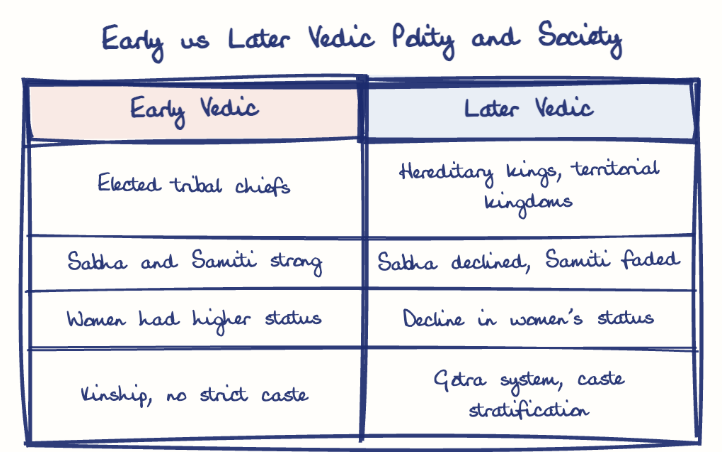
Early Vedic tribes were led by chiefs answerable to the Sabha and Samiti; Later Vedic janapadas were ruled by hereditary kings with centralized authority.
Social Stratification and Gender Roles
Early Vedic society was fluid, with women participating in assemblies and enjoying relatively high status. The Later Vedic era introduced a rigid varna system dividing society into Brahmanas, Kshatriyas, Vaishyas and Shudras, while women lost their place in assemblies and their access to Vedic learning narrowed.
Pastoral to Agrarian Economy
Cattle wealth and barter gave way to settled plough agriculture using iron tools after forest clearing in the Ganga valley.
Taxation and Resource Management
Early Vedic resource distribution was informal and voluntary. Later Vedic society developed formal taxation systems such as bali, shulka, and bhaga, managed by officials like the Sangrihitri, indicating increased state capacity and economic complexity.
Religious Complexity and Philosophy
Early Vedic religion focused on nature worship and simple fire rituals to deities like Indra and Agni. Later Vedic religion became more elaborate, with Brahmin priests conducting complex sacrifices such as Ashvamedha and Vajapeya, alongside the emergence of Upanishadic philosophical ideas and folk elements in the Atharvaveda.
Patriarchal Family and Fire Rituals
Both periods maintained the patriarchal joint family as the social unit and continued polytheistic worship centered on fire sacrifices, showing religious and social continuity despite other changes.
This model answer is indicative and the model can make mistakes; please verify key facts independently.
Sources
Practise this question
1Get the answer sheet
Sized for this question.
2Write your answer
Timed, by hand.
3Get it marked
Your score and what to fix.
This chapter in the exam
Ancient India - Pre-history, IVC, Vedic, Mauryas, Kushans, Satavahanas, Sangam, Guptas16 questions
Asked in 8 of 8 sittings since 2008
Most tested: Harappan civilisation—urban planning, origin/decline, and continuity.
- 2025Discuss the origin and expansion of the Indus Valley Civilization.
- 2025Briefly analyze the teachings of Buddha and Mahavira.
All 16 questions, sorted by sub-topic, with model answers and practice.
Question from the official APPSC Group-I Mains 2008 paper. Answer written by Ghissu's engine and checked against our editorial standards. Found an error? Tell us and we correct it within 48 hours.