Critically examine the role played by Ittehadul Muslimeen, during the rule of the VIIth Nizam of Hyderabad.
In short
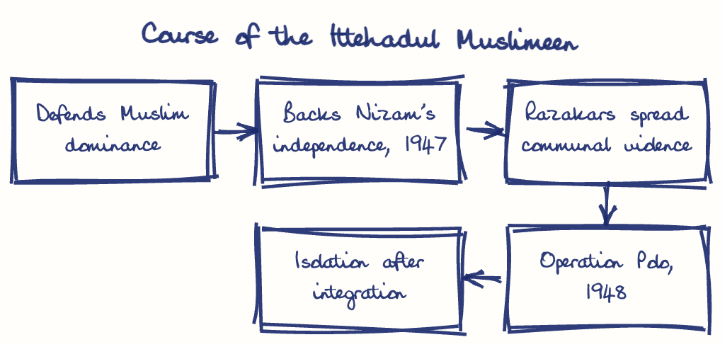
Under the VIIth Nizam, the Ittehadul Muslimeen championed Muslim political dominance, backed the Nizam's June 1947 declaration of independence and opposed the Hyderabad State Congress, mobilising through its Razakar wing under Qasim Razvi. Its communal violence alienated the majority and provoked Operation Polo in September 1948, ending the Nizam's rule.
Model answer
Ghissu Editorial · Verified 4 Oct 2026 · 303 words
Defender of Muslim Political Dominance
Ittehad opposed the Hyderabad State Congress1 and supported the Nizam’s vision of an independent Muslim-ruled Hyderabad, resisting accession to India or Pakistan. It sought to preserve Muslim aristocratic privileges against democratic reforms.
Support for Nizam’s Sovereignty
Ittehad backed the Nizam’s June 1947 declaration of independence, reinforcing autocratic Muslim elite governance and opposing integration with India.
Strengthening Autocracy and Exclusion
Ittehad’s support for the Nizam marginalized Hindus and other communities, deepening political exclusion and resisting democratic movements.
Communal Violence and Indian Intervention
Razakars’ violent acts escalated communal tensions, undermining social cohesion and provoking the Indian government’s Operation Polo in 1948 that ended Nizam’s rule.
Undermining Democratic Movements
The party’s opposition to the Hyderabad State Congress and Telangana peasant uprising hindered representative governance and prolonged instability.
Preservation of Muslim Elite Power
Ittehad maintained Muslim dominance and sovereignty aspirations temporarily, rallying significant support among Muslim aristocracy.
Failure in Inclusive Governance
Narrow focus on Muslim interests alienated the Hindu majority and marginalized other groups, limiting legitimacy.
Provocation of Communal Conflict
Razakars’ violence delegitimized the party and hastened political downfall.
Inability to Adapt Politically
Underestimating Indian resolve and popular demand for integration led to political isolation and collapse after 1948.
This model answer is indicative and the model can make mistakes; please verify key facts independently.
Sources
Practise this question
1Get the answer sheet
Sized for this question.
2Write your answer
Timed, by hand.
3Get it marked
Your score and what to fix.
This chapter in the exam
Andhra - Modern14 questions
Asked in 5 of 8 sittings since 2008
Most tested: Social awakening in Andhra through education, print/language reform, and reform personalities.
- 2025Discuss the role of missionaries in the growth and spread of education in Andhra region.
- 2025What factors contributed to the process of social awakening in the Andhra region in the second half of the 19th century?
All 14 questions, sorted by sub-topic, with model answers and practice.
Question from the official APPSC Group-I Mains 2008 paper. Answer written by Ghissu's engine and checked against our editorial standards. Found an error? Tell us and we correct it within 48 hours.