Estimate the significance of Library Movement in Telangana.
In short
The Library Movement in Telangana was a grassroots people's movement that spread literacy, Telugu culture and reformist ideas, keeping Telugu learning alive under the Nizam's neglect. Its pioneers were the Sri Krishnadevaraya Andhra Bhasha Nilayam (1901) in Hyderabad and the Rajaraja Narendra Andhra Bhasha Nilayam at Hanamkonda (1904).
Model answer
Ghissu Editorial · Verified 4 Oct 2026 · 259 words
Grassroots Origins
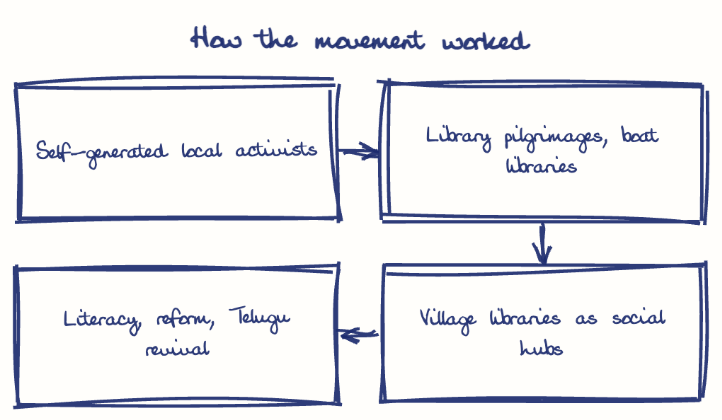
The movement was driven by passionate volunteers spreading literacy in rural and urban Telangana without direct government initiation, reflecting strong community ownership and self-reliance.
Pioneering Institutions
The Sri Krishnadevaraya Andhra Bhasha Nilayam (1901) in Hyderabad and the Rajaraja Narendra Andhra Bhasha Nilayam at Hanamkonda (1904) became models for village libraries, which the Andhra Mahasabha spread as centres of Telugu learning under the Nizam.
Social Reform Catalyst
Progressive literature encouraged debates on caste discrimination and women’s rights, nurturing social consciousness. The movement also supported language and social reform movements, contributing to political awakening.
Foundation for Knowledge Societies
The movement influenced policies for inclusive education and digital access, linking to welfare schemes like Rythu Bharosa1 and Rajiv Aarogyasri that empower marginalized groups.
Digital Integration and Community Engagement
Digitizing resources and strengthening reading clubs, cultural events, and library pilgrimages can revive libraries as vibrant social spaces.
Targeted Literacy Campaigns
Focus on backward districts like Narayanpet and Jogulamba-Gadwal by leveraging libraries as centers for adult education and skill development.
This model answer is indicative and the model can make mistakes; please verify key facts independently.
Practise this question
1Get the answer sheet
Sized for this question.
2Write your answer
Timed, by hand.
3Get it marked
Your score and what to fix.
This chapter in the exam
Andhra - Nationalist Movement and Formation of the State22 questions
Asked in 8 of 8 sittings since 2008
Most tested: Formation of Andhra Pradesh and the Andhra-Telangana statehood process
- 2025What were the provisions of the Gentlemen's Agreement of 1956? How far could they satisfy apprehensions of the Telangana region?
- 2025Outline the role of the students in raising major issues in the 1969 Telangana agitation.
All 22 questions, sorted by sub-topic, with model answers and practice.
Question from the official APPSC Group-I Mains 2008 paper. Answer written by Ghissu's engine and checked against our editorial standards. Found an error? Tell us and we correct it within 48 hours.