Give an account of the socio-religious and cultural conditions in Andhra desha during the years 1000 - 1565 A.D.
In short
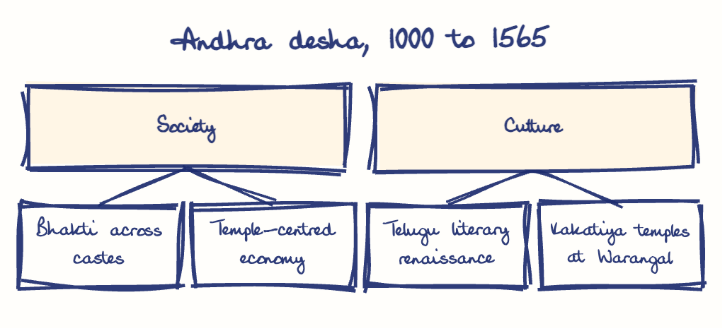
Between 1000 and 1565 A.D., Andhra desha saw Shaivism and Vaishnavism displace Buddhism and Jainism, temple-centred social life, caste and guild structures, and Bhakti movements. Culturally it was a Telugu renaissance, from Tikkana, Srinatha and Pothana to Allasani Peddana at Krishnadevaraya's court, alongside Kakatiya and Vijayanagara temple building.
Model answer
Ghissu Editorial · Verified 4 Oct 2026 · 245 words
Temple as Socio-Economic Centers
Temples like Draksharama received land grants and wealth from rulers, supporting priests, artisans, and traders, thus integrating religion with the economy. These temples functioned as hubs for social organization, education, and cultural activities, reinforcing the authority of religious elites and local communities.
Architectural and Artistic Achievements
Kakatiya temples at Warangal and Vijayanagara ruins exhibit Dravidian styles with local innovations, featuring intricate carvings and towering gopurams. Music and dance thrived in temples and courts, with patronage fostering classical forms that influenced later South Indian traditions.
Heritage Preservation and Promotion
Enhance conservation of Kakatiya and Vijayanagara monuments through increased funding and community involvement, and promote Telugu literature by supporting translations and modern dissemination to sustain cultural legacy.
Inclusive Cultural Policies
Support marginalized groups, including women and occupational guilds, in cultural preservation and performance arts, and foster interfaith dialogue initiatives that build on the historical tradition of syncretism and tolerance in Andhra desha.
This model answer is indicative and the model can make mistakes; please verify key facts independently.
Practise this question
1Get the answer sheet
Sized for this question.
2Write your answer
Timed, by hand.
3Get it marked
Your score and what to fix.
This chapter in the exam
Andhra - Medieval16 questions
Asked in 8 of 8 sittings since 2008
Most tested: Telugu language and literature under medieval dynasties, especially Kakatiya, Qutub Shahi, Reddi, and Vijayanagara patronage.
- 2025Discuss the growth of various Saivite sects during the Kakatiya rule.
- 2025Discuss the significance of the Warangal Fort complex as a historical monument.
All 16 questions, sorted by sub-topic, with model answers and practice.
Question from the official APPSC Group-I Mains 2008 paper. Answer written by Ghissu's engine and checked against our editorial standards. Found an error? Tell us and we correct it within 48 hours.