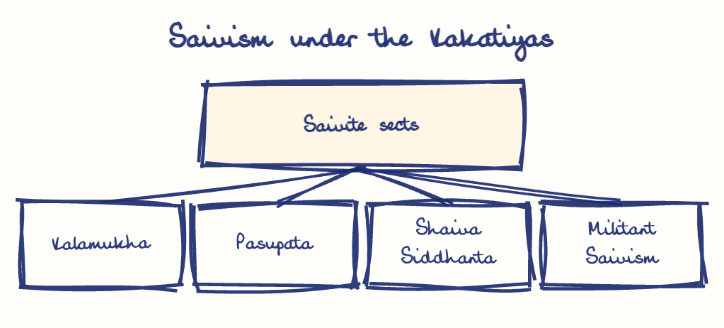
Discuss the growth of various Saivite sects during the Kakatiya rule.
In short
Under the Kakatiyas, Saivism grew through the Kalamukha, Pasupata, Shaiva Siddhanta and Virasaiva sects, aided by royal patronage, Jainism's decline and the inclusion of lower castes. Temples like the Thousand Pillar and Ramappa became Saivite centres, and Palkurki Somanatha's Basava Puranam spread devotional Saivism in Telugu.
Model answer
Ghissu Editorial · Verified 4 Oct 2026 · 280 words
Kalamukha Sect
Early Kakatiyas like Rudradeva were initiated into this sect, which emphasized devotion to Shiva and a liberal caste outlook, helping spread Saivism widely.
Royal Patronage
Kings like Rudradeva and Ganapati Deva granted lands and resources for Saivite temples, fostering sect expansion and temple construction.
Decline of Jainism
Militant Saivism caused Jainism’s decline; Jain temples were converted to Saivite shrines, e.g., Padmashi temple at Anamakonda, signaling a shift in religious power.
Social Integration
Saivite sects embraced tribal and lower castes, aided by the Kakatiyas’ Sudra origins, broadening their social base and appeal.
Temple Architecture
Monuments like the Ramappa and Thousand Pillar temples served as cultural and religious centers, reinforcing Saivism’s prominence.
Social Integration
Saivism challenged caste rigidity, promoting inclusion and mobility, exemplified by Virasaivism, which welcomed devotees irrespective of caste.
Cultural Flourishing
Patronage of temple arts and performing arts like Perini Shivatandavam defined Kakatiya culture, with artistic achievements such as the Madanikas of Ramappa temple.
Religious Conflict
Militant Saivism led to sectarian clashes and Jain decline, reflecting complex religious dynamics.
Literary Contributions
Saivite poets like Palkurki Somanatha enriched Telugu literature with works such as Panditaradhya Charitra, preserving religious and cultural narratives.
This model answer is indicative and the model can make mistakes; please verify key facts independently.
Practise this question
1Get the answer sheet
Sized for this question.
2Write your answer
Timed, by hand.
3Get it marked
Your score and what to fix.
This chapter in the exam
Andhra - Medieval16 questions
Asked in 8 of 8 sittings since 2008
Most tested: Telugu language and literature under medieval dynasties, especially Kakatiya, Qutub Shahi, Reddi, and Vijayanagara patronage.
- 2025Discuss the significance of the Warangal Fort complex as a historical monument.
- 2023Examine the socio-religious and cultural life of the Vijayanagara kingdom with respect to the writings of foreign travellers such as Nicolo Conti, Abdur Razzak, Duarte Barbosa and Domingo Paes.
All 16 questions, sorted by sub-topic, with model answers and practice.
Question from the official APPSC Group-I Mains 2025 paper. Answer written by Ghissu's engine and checked against our editorial standards. Found an error? Tell us and we correct it within 48 hours.