What are the factors that led to the rise and growth of socio-cultural awakening in Andhra during the 20th century?
In short
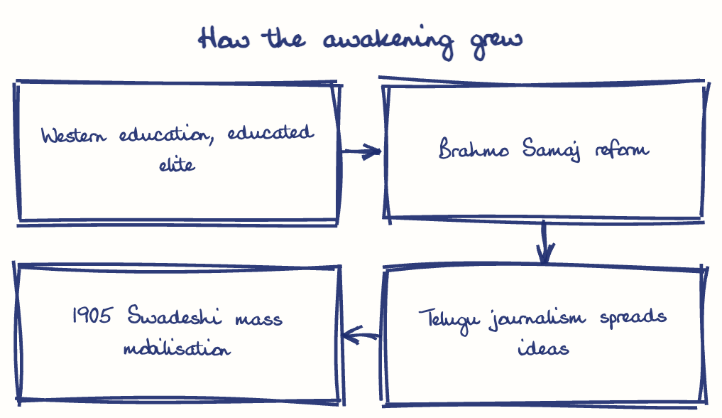
Andhra's twentieth-century socio-cultural awakening grew from Western education, Brahmo Samaj reform, Telugu journals like Andhra Prakasika and Krishna Patrika, and political mobilisation after the 1905 Swadeshi and Vandemataram movements. It found expression in the Andhra Mahasabha and the movement for a separate Telugu state.
Model answer
Ghissu Editorial · Verified 4 Oct 2026 · 281 words
Western Education Expansion
Universities and colleges in Rajahmundry, Visakhapatnam, and Berhampur introduced modern education, creating elites who questioned tradition and colonialism. This new educated class became the backbone of social reform and political leadership.
Socio-Religious Reform Movements
The Brahmo Samaj’s branches in Rajahmundry, Masulipatnam, and Kakinada challenged caste and superstition, promoting social reforms. Alongside, reformers advocated against untouchability and child marriage, fostering progressive social values.
Telugu Journalism and Literary Platforms
Andhra Prakasika, Krishna Patrika, and the Coconada Literary Association spread nationalist ideas and social critique, energizing public opinion. These platforms also nurtured Telugu language and culture, strengthening regional identity.
Political Mobilization and Nationalism
District associations like Krishna District Association at Machilipatnam and Congress participation post-1905 Swadeshi movement heightened political consciousness. The partition of Bengal and Vandemataram movement further galvanized mass participation in Andhra’s nationalist struggle.
Inclusive Education and Social Welfare
Expanding Samagra Shiksha Abhiyan1 and schemes like Mission Shakti can empower marginalized groups and continue social progress. Promoting grassroots political engagement and supporting cultural platforms will sustain democratic and social reforms.
This model answer is indicative and the model can make mistakes; please verify key facts independently.
Practise this question
1Get the answer sheet
Sized for this question.
2Write your answer
Timed, by hand.
3Get it marked
Your score and what to fix.
This chapter in the exam
Andhra - Modern14 questions
Asked in 5 of 8 sittings since 2008
Most tested: Social awakening in Andhra through education, print/language reform, and reform personalities.
- 2025Discuss the role of missionaries in the growth and spread of education in Andhra region.
- 2025What factors contributed to the process of social awakening in the Andhra region in the second half of the 19th century?
All 14 questions, sorted by sub-topic, with model answers and practice.
Question from the official APPSC Group-I Mains 2008 paper. Answer written by Ghissu's engine and checked against our editorial standards. Found an error? Tell us and we correct it within 48 hours.