"Article 356 is more misused than used." — Comment.
In short
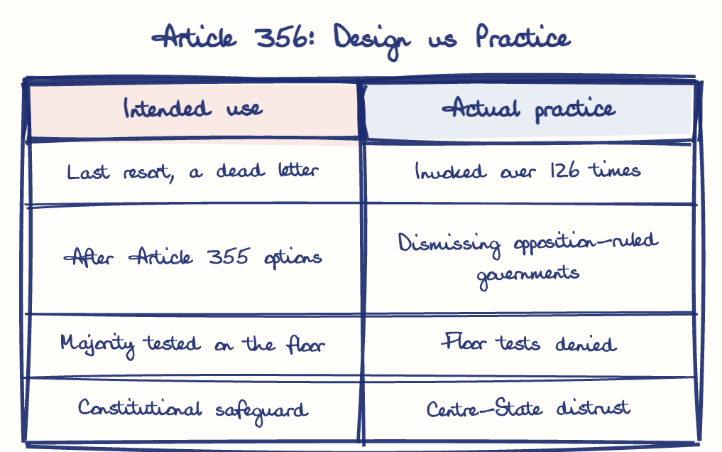
Article 356 has historically been misused more than properly used, invoked over 126 times, often to dismiss opposition state governments without a floor test. Since the Bommai judgment (1994) made such proclamations subject to judicial review and floor tests, its misuse has sharply declined.
Model answer
Ghissu Editorial · Verified 4 Oct 2026 · 254 words
Commission Recommendations
The Sarkaria and Punchhi Commissions emphasized exhausting alternatives like Article 355 and paramilitary deployment, strict guidelines, and constitutional conventions to uphold federalism and prevent misuse. They advocated that Article 356 be a measure of last resort, used only in severe crises such as political deadlock or internal subversion.
Judicial and Political Reforms
Post-S.R. Bommai, judicial scrutiny and coalition politics reduced misuse, but challenges remain in ensuring due process and cooperative federalism. Instances like the Uttarakhand case (2016) show denial of floor tests still occur, highlighting ongoing implementation gaps.
Transparency and Judicial Empowerment
Governor's reports should be made public and floor tests made mandatory before any proclamation, while prompt court adjudication can reinforce constitutional checks against misuse.
Promoting Cooperative Federalism
Dialogue platforms like the Inter-State Council can resolve conflicts amicably, reducing reliance on Article 356. Strengthening political maturity and respect for federalism, especially in sensitive states such as Andhra Pradesh, is essential.
This model answer is indicative and the model can make mistakes; please verify key facts independently.
Sources
Practise this question
1Get the answer sheet
Sized for this question.
2Write your answer
Timed, by hand.
3Get it marked
Your score and what to fix.
This chapter in the exam
Judiciary in India15 questions
Asked in 8 of 8 sittings since 2008
Most tested: Judicial review and its scope/limits
- 2025What are the emergency functions of the Union Government of India? Describe how they impact the legislative powers of Parliament and State Legislatures.
- 2025Discuss any two constitutional amendments that have significantly affected the powers or functioning of the Indian judiciary.
All 15 questions, sorted by sub-topic, with model answers and practice.
Question from the official APPSC Group-I Mains 2008 paper. Answer written by Ghissu's engine and checked against our editorial standards. Found an error? Tell us and we correct it within 48 hours.