Bring out the politics of Women's Reservation Bill.
In short
The Women's Reservation Bill stalled for decades as parties backed it publicly but fielded few women, and disputes over OBC and minority sub-quotas blocked it after Rajya Sabha passage in 2010. It finally became the 106th Amendment Act, 2023, but implementation awaits the census and delimitation.
Model answer
Ghissu Editorial · Verified 4 Oct 2026 · 263 words
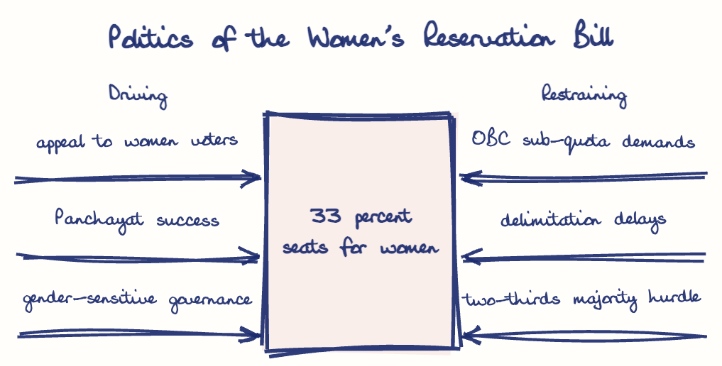
Sub-Quota Controversy
Parties such as Samajwadi and Bahujan Samaj demand sub-quotas for OBC and minority women, causing deadlock in Parliament and highlighting the intersectional challenges within women’s representation.
Delimitation Freeze
The Bill’s implementation is linked to delimitation, frozen until 2026, delaying reservation until likely after 2029 elections and dampening political will for immediate action.
Mixed Party Records
Congress introduced a 33% quota internally in 1998 but nominates few women; BJP also has low women representation in leadership, reflecting a gap between rhetoric and practice.
Women’s Movements and Panchayat Success
Women’s groups advocate the Bill, citing 43-47% women representation in Panchayats, including Andhra Pradesh, as evidence of reservation’s positive impact on grassroots democracy and empowerment.
Legislative Challenges
Before 2023 the Bill repeatedly lapsed in the Lok Sabha4, showing fragmented political consensus, until the 106th Amendment Act passed almost unanimously in 2023.
Current Representation Gap
Women hold ~10% seats in Rajya Sabha and ~15% in Lok Sabha, underscoring the Bill’s necessity to institutionalize one-third reservation and bridge this gender gap.
This model answer is indicative and the model can make mistakes; please verify key facts independently.
Practise this question
1Get the answer sheet
Sized for this question.
2Write your answer
Timed, by hand.
3Get it marked
Your score and what to fix.
This chapter in the exam
Parliament and State Legislatures13 questions
Asked in 8 of 8 sittings since 2008
Most tested: Comparative powers and status of the two Houses, especially Rajya Sabha vs Lok Sabha and Legislative Council vs Legislative Assembly.
- 2025In what aspects is the Legislative Council (Vidhan Parishad) different from the Rajya Sabha, considering its role at the state level?
- 2025What are the steps followed by the Indian Parliament in transforming a Bill into an Act?
All 13 questions, sorted by sub-topic, with model answers and practice.
Question from the official APPSC Group-I Mains 2008 paper. Answer written by Ghissu's engine and checked against our editorial standards. Found an error? Tell us and we correct it within 48 hours.