What are the steps followed by the Indian Parliament in transforming a Bill into an Act?
In short
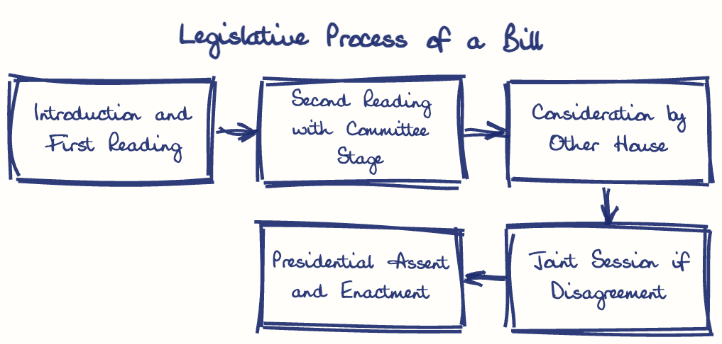
A Bill becomes an Act after introduction and first reading, a second reading with discussion, committee scrutiny and clause-by-clause consideration, a third reading, the same stages in the other House, and Presidential assent. Deadlocks on ordinary bills go to a joint sitting, and Money Bills start in the Lok Sabha.
Model answer
Ghissu Editorial · Verified 4 Oct 2026 · 312 words
Introduction and First Reading
Bills can be introduced in either House by ministers or members; the Bill’s title and objectives are read without debate and published in the Gazette.
Lok Sabha and Rajya Sabha Roles
Both Houses must agree on the Bill’s text; Money Bills originate only in Lok Sabha, highlighting its financial supremacy, while Rajya Sabha’s committee work ensures detailed scrutiny.
President’s Assent
After passage by both Houses, the Bill is sent to the President who can give assent, withhold it, or return the Bill (except Money Bills); assent is mandatory if Parliament passes the Bill again.
Money Bills and Constitutional Amendments
The Rajya Sabha must return Money Bills within 14 days with only recommendations; constitutional amendment Bills require special majorities and state ratification.
Committees and Joint Sessions
Select Committees of Lok Sabha3 and Joint Committees of both Houses, plus Joint Sessions, resolve disagreements, exemplified by the Select Committee on the Income Tax Bill, 2025.
This model answer is indicative and the model can make mistakes; please verify key facts independently.
Practise this question
1Get the answer sheet
Sized for this question.
2Write your answer
Timed, by hand.
3Get it marked
Your score and what to fix.
This chapter in the exam
Parliament and State Legislatures13 questions
Asked in 8 of 8 sittings since 2008
Most tested: Comparative powers and status of the two Houses, especially Rajya Sabha vs Lok Sabha and Legislative Council vs Legislative Assembly.
- 2025In what aspects is the Legislative Council (Vidhan Parishad) different from the Rajya Sabha, considering its role at the state level?
- 2023Describe the matters in which the Legislative Council stands equal with the Legislative Assembly along with the matters in which it stands unequal with the Legislative Assembly.
All 13 questions, sorted by sub-topic, with model answers and practice.
Question from the official APPSC Group-I Mains 2025 paper. Answer written by Ghissu's engine and checked against our editorial standards. Found an error? Tell us and we correct it within 48 hours.