Comment on the declining trend of legislative debates.
In short
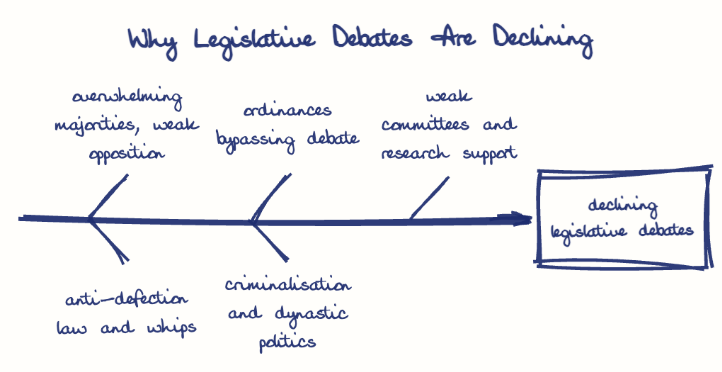
Legislative debate has declined because of single-party majorities, the anti-defection law and party whips, frequent ordinances, fewer committee referrals and weak research support, eroding executive accountability. The 17th Lok Sabha sat only about 55 days a year, against about 135 days in the first Lok Sabha.
Model answer
Ghissu Editorial · Verified 4 Oct 2026 · 261 words
Maharashtra Assembly1 Instability
The Maharashtra Assembly’s low sittings and frequent disruptions exemplify legislative dysfunction and political instability, limiting effective representation and debate. This crisis reflects broader challenges in state legislatures affecting governance quality.
Budget Passed Without Discussion
From 2019 to 2023, around 80% of the budget was passed without any discussion, signaling a sharp decline in legislative scrutiny and eroding public trust in parliamentary processes.
Increase in Ordinances and Reduced Debate
Ordinance promulgations have increased by 109% compared to 2009, allowing the executive to bypass parliamentary debate and weakening legislative oversight, as seen in frequent use during recent years.
Decline in Committee Referrals and Research Support
The referral of bills to parliamentary committees dropped from 71% in the 15th Lok Sabha to 25% in the 16th, reducing detailed scrutiny. Additionally, inadequate research support limits legislators’ capacity for informed debate.
Fix Minimum Sittings
Implement the National Commission to Review the Working of the Constitution2’s recommendation of at least 120 Lok Sabha and 100 Rajya Sabha sittings annually to ensure sufficient time for debates and accountability.
This model answer is indicative and the model can make mistakes; please verify key facts independently.
Practise this question
1Get the answer sheet
Sized for this question.
2Write your answer
Timed, by hand.
3Get it marked
Your score and what to fix.
This chapter in the exam
Parliament and State Legislatures13 questions
Asked in 8 of 8 sittings since 2008
Most tested: Comparative powers and status of the two Houses, especially Rajya Sabha vs Lok Sabha and Legislative Council vs Legislative Assembly.
- 2025In what aspects is the Legislative Council (Vidhan Parishad) different from the Rajya Sabha, considering its role at the state level?
- 2025What are the steps followed by the Indian Parliament in transforming a Bill into an Act?
All 13 questions, sorted by sub-topic, with model answers and practice.
Question from the official APPSC Group-I Mains 2008 paper. Answer written by Ghissu's engine and checked against our editorial standards. Found an error? Tell us and we correct it within 48 hours.