What are the novel trends in Judicial Review ?
In short
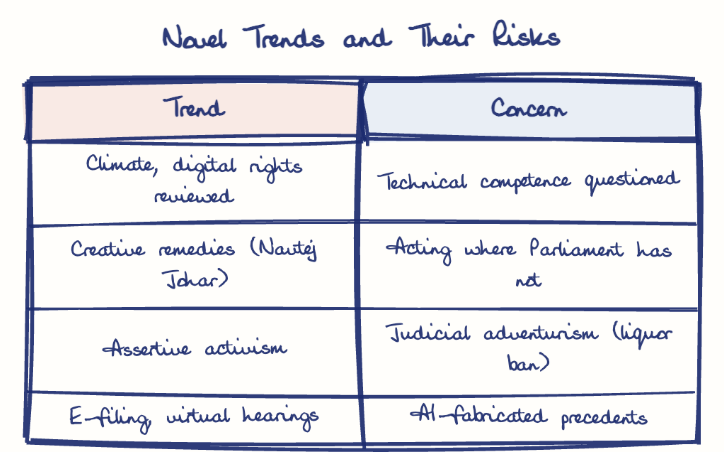
Novel trends in judicial review include its expansion into climate and digital rights, creative remedies that fill policy gaps, a shifting balance of activism and restraint, and technology such as e-filing and virtual hearings. In the Ranjitsinh case (2024), the Supreme Court recognised government accountability for climate change.
Model answer
Ghissu Editorial · Verified 4 Oct 2026 · 248 words
Innovative Remedies and Activism
Navtej Singh Johar (2018) decriminalized Section 377 IPC, advancing LGBTQ+ rights, while the Bilkis Bano case (Bilkis Yakub Rasool v. Union of India, 2024) quashed remission of convicts, showing proactive judicial intervention. Such activism fills legislative gaps but raises debates on judicial overreach and separation of powers.
Challenges to Separation of Powers
The Tribunals Reforms Act1 (2021) and NJAC Act (2015) controversies reveal strains on judicial independence and institutional autonomy. These episodes highlight tensions between judiciary and legislature in appointments and policy domains.
Judicial Accountability and Public Trust
The Law Commission2’s 195th Report (2006) recommended a National Judicial Council to address accountability amid concerns over judicial overreach. High vacancy rates in courts, especially in Andhra Pradesh, further impact timely justice and public confidence.
Institutionalize Accountability
Implement Law Commission recommendations to enhance judicial transparency and ethical standards through a National Judicial Oversight Committee.
This model answer is indicative and the model can make mistakes; please verify key facts independently.
Practise this question
1Get the answer sheet
Sized for this question.
2Write your answer
Timed, by hand.
3Get it marked
Your score and what to fix.
This chapter in the exam
Judiciary in India15 questions
Asked in 8 of 8 sittings since 2008
Most tested: Judicial review and its scope/limits
- 2025What are the emergency functions of the Union Government of India? Describe how they impact the legislative powers of Parliament and State Legislatures.
- 2025Discuss any two constitutional amendments that have significantly affected the powers or functioning of the Indian judiciary.
All 15 questions, sorted by sub-topic, with model answers and practice.
Question from the official APPSC Group-I Mains 2008 paper. Answer written by Ghissu's engine and checked against our editorial standards. Found an error? Tell us and we correct it within 48 hours.