Briefly explain the need for administering agricultural commodity prices and mention the administering machinery.
In short
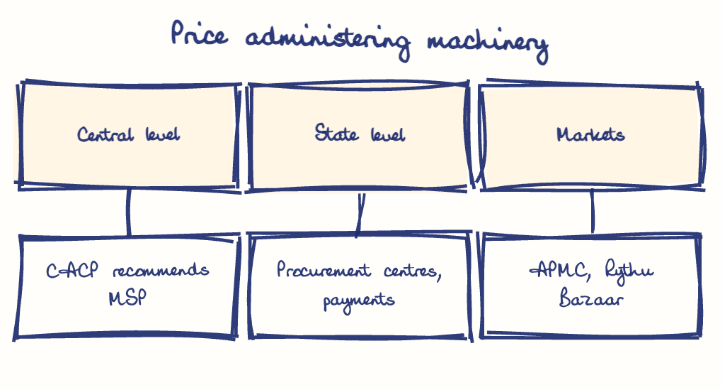
Agricultural commodity prices are administered to protect farmers from volatile markets, encourage investment in production and ensure food security for consumers. The machinery includes the CACP recommending MSPs for 23 commodities, the Essential Commodities Act, 1955, state APMC Acts and regulated markets, state procurement agencies and Andhra Pradesh's Rythu Bazaars.
Model answer
Ghissu Editorial · Verified 4 Oct 2026 · 263 words
Legal Foundations
The Essential Commodities Act, 1955, and state APMC Acts provide statutory backing for regulating procurement, storage, and price control, enabling government intervention during price fluctuations.
MSP Mechanism
The Commission for Agricultural Costs and Prices (CACP) recommends MSPs for 23 commodities based on costs, demand-supply, and market trends, influencing cropping patterns and production decisions.
State-Level Administration
Andhra Pradesh implements procurement and price support schemes, managing centers, storage, and payments to operationalize price administration effectively.
Market Regulation and Reforms
APMC mandates regulated markets to reduce middlemen exploitation; initiatives like Rythu Bazaar promote direct farmer sales, improving price realization and transparency.
Market Fragmentation and Payment Delays
Middlemen dominate despite regulation, capturing large price shares; delayed payments at procurement centers discourage farmer participation and weaken price support.
Enhance Awareness and Infrastructure
Use digital platforms and extension services to inform farmers about MSP and price support; invest in scientific storage, assaying, and cold chains in Andhra Pradesh to reduce losses.
Promote Direct Marketing and Technology
Scale up Rythu Bazaar and Farmer Producer Organisations to aggregate produce and improve bargaining power; integrate e-NAM and commodity futures markets for better transparency, price discovery, and risk management.
This model answer is indicative and the model can make mistakes; please verify key facts independently.
Sources
Practise this question
1Get the answer sheet
Sized for this question.
2Write your answer
Timed, by hand.
3Get it marked
Your score and what to fix.
This chapter in the exam
Agricultural Development (India)16 questions
Asked in 7 of 8 sittings since 2008
Most tested: Agricultural credit and market regulation/price policy.
- 2025Examine the significance of agriculture finance, production, and marketing in the context of India's agricultural development. Discuss the challenges and opportunities associated with financing agricultural activities, improving production, and developing efficient marketing systems to support sustainable growth in the agricultural sector.
- 2025Explain the role of the Agricultural Produce Market Committee (APMC) Act in Agricultural Price Policy in regulating the agricultural market in India. What are the issues that have been observed by policy makers regarding the functioning of the APMC Act?
All 16 questions, sorted by sub-topic, with model answers and practice.
Question from the official APPSC Group-I Mains 2008 paper. Answer written by Ghissu's engine and checked against our editorial standards. Found an error? Tell us and we correct it within 48 hours.