Explain the role of the Agricultural Produce Market Committee (APMC) Act in Agricultural Price Policy in regulating the agricultural market in India. What are the issues that have been observed by policy makers regarding the functioning of the APMC Act?
In short
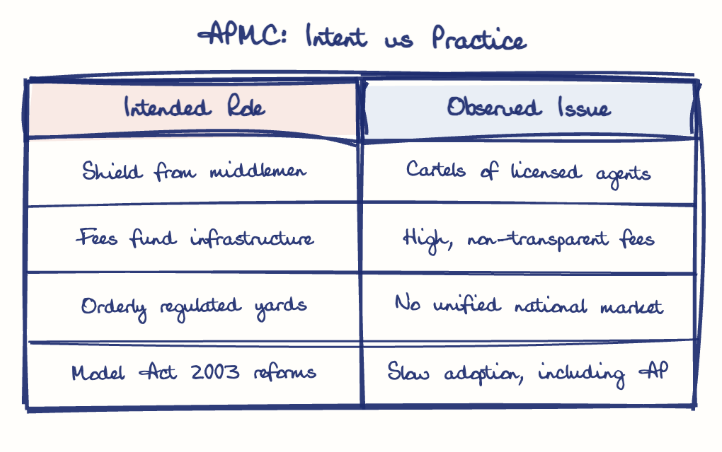
APMC Acts regulate agricultural markets by requiring the first sale of notified produce in licensed mandis, enabling price discovery, MSP procurement and market fees that fund infrastructure. Policymakers have flagged market fragmentation, cartels of commission agents, high non-transparent fees, too few mandis and slow adoption of Model APMC reforms.
Model answer
Ghissu Editorial · Verified 4 Oct 2026 · 278 words
Market Fees and Infrastructure Funding
APMCs levy fees and commissions to finance market infrastructure, but these act as quasi-taxes, increasing farmers’ marketing costs and reducing price realisation.
Licensing and Market Control
The Act mandates licensing of traders and commission agents, controlling market access but often leading to cartelisation and limited competition.
Restrictions on Direct Sales
Farmers are generally required to sell within notified mandis, limiting access to alternative buyers; states3 like Andhra Pradesh have been slow to implement Model APMC Act reforms allowing direct sales and special markets.
Market Fragmentation and Lack of National Market
Thousands of fragmented mandis under different state laws hinder unified national markets and efficient price discovery.
Monopolistic Practices and Political Influence
Cartels among licensed agents and political patronage in APMC committees inflate commission charges, reducing farmers’ net income.
High Transaction Costs and Non-Transparency
Multiple fees and commissions increase costs and undermine trust in the system.
This model answer is indicative and the model can make mistakes; please verify key facts independently.
Practise this question
1Get the answer sheet
Sized for this question.
2Write your answer
Timed, by hand.
3Get it marked
Your score and what to fix.
This chapter in the exam
Agricultural Development (India)16 questions
Asked in 7 of 8 sittings since 2008
Most tested: Agricultural credit and market regulation/price policy.
- 2025Examine the significance of agriculture finance, production, and marketing in the context of India's agricultural development. Discuss the challenges and opportunities associated with financing agricultural activities, improving production, and developing efficient marketing systems to support sustainable growth in the agricultural sector.
- 2023Discuss the types and sources of agricultural credit in India. Explain the initiatives taken by the Indian Government in order to improve access to agricultural credit.
All 16 questions, sorted by sub-topic, with model answers and practice.
Question from the official APPSC Group-I Mains 2025 paper. Answer written by Ghissu's engine and checked against our editorial standards. Found an error? Tell us and we correct it within 48 hours.