Examine the causes for regional disparities in Andhra Pradesh and measures initiated by the government to reduce the same.
In short
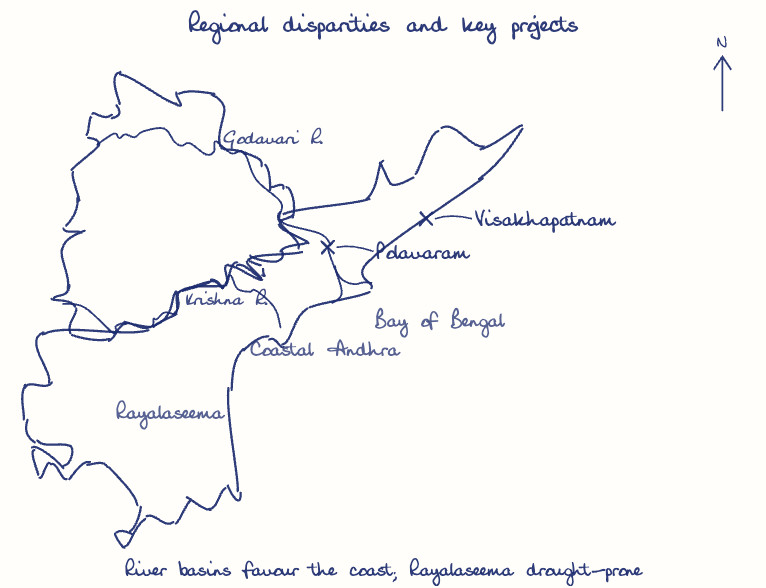
Regional disparities in Andhra Pradesh stem from the 2014 loss of Hyderabad, Rayalaseema's chronic drought, infrastructure concentrated in coastal Andhra, skewed irrigation investment and governance lapses. The government responds through Swarna Andhra Vision 2047, Annadatha Sukhibhava, the Polavaram National Project, APCNF and stronger local bodies.
Model answer
Ghissu Editorial · Verified 4 Oct 2026 · 272 words
Bifurcation and Geography
The 2014 bifurcation deprived residual Andhra Pradesh of Hyderabad, its key economic hub; Rayalaseema suffers chronic drought and water scarcity, unlike fertile coastal Andhra. This geographic disadvantage limits agricultural productivity and industrial growth in Rayalaseema.
Infrastructure and Health Deficits
Coastal Andhra benefits from port-led industrial corridors like Visakhapatnam-Chennai; Rayalaseema lags in transport and health infrastructure, as per the Andhra Pradesh Health Infrastructure2 CAG report 2024 showing shortages in Community Health Centres and medical staff. Additionally, fiscal constraints and governance inefficiencies exacerbate these gaps, with the CAG audit of Andhra Pradesh welfare funds (2025) revealing fund diversion affecting backward regions.
Development Vision and Welfare Schemes
The Swarna Andhra Vision 2047 targets balanced regional growth; schemes like Annadatha Sukhibhava and the Crop Cultivators Right Act support farmers; education is boosted by Samagra Shiksha Abhiyan and ULLAS Scheme. AP Community Managed Natural Farming (APCNF) also aims to improve agricultural sustainability in drought-prone areas.
This model answer is indicative and the model can make mistakes; please verify key facts independently.
Practise this question
1Get the answer sheet
Sized for this question.
2Write your answer
Timed, by hand.
3Get it marked
Your score and what to fix.
This chapter in the exam
Inclusive Growth: India and AP schemes49 questions
Asked in 8 of 8 sittings since 2008
Most tested: Women empowerment and poverty reduction through AP welfare and credit-linked institutions
- 2025Elaborate on the meaning of Inclusive Growth in the context of the Indian economy. Discuss the key strategies and instruments that can be employed to foster greater inclusion and ensure that the benefits of economic growth reach all sections of society.
- 2025Critically Examine the major poverty alleviation and employment generation programmes in India. How effective have they been in addressing rural and urban poverty?
All 49 questions, sorted by sub-topic, with model answers and practice.
Question from the official APPSC Group-I Mains 2008 paper. Answer written by Ghissu's engine and checked against our editorial standards. Found an error? Tell us and we correct it within 48 hours.