Critically Examine the major poverty alleviation and employment generation programmes in India. How effective have they been in addressing rural and urban poverty?
In short
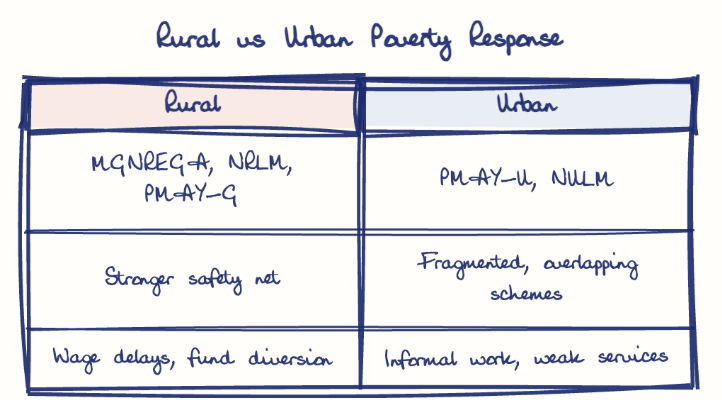
India's poverty alleviation and employment programmes, including MGNREGA, PMAY, NRLM, food security under NFSA and Mudra, have reduced rural poverty most, while urban poverty persists amid fragmented schemes and weak services. Multidimensional poverty fell from 29.17% in 2013-14 to 11.28% in 2022-23, and PMAY-G built over 2.69 crore houses.
Model answer
Ghissu Editorial · Verified 4 Oct 2026 · 271 words
MGNREGA’s Impact
Guarantees 100 days of rural work, crucial during COVID-19 with a 30% demand increase; however, wage delays and low pay persist. It also supports asset creation and drought resilience in rural areas.
Housing and Livelihoods
Pradhan Mantri Awas Yojana Gramin built over 2.69 crore houses improving rural living; NRLM’s SHGs enhance self-employment but face bureaucratic delays. The National Food Security Act complements these by ensuring subsidised food to vulnerable populations.
Skill and Entrepreneurship
Skill India Digital Platform, PMMY, and Stand-Up India promote skills and credit; Employment Linked Incentive Scheme encourages formal employment. Apprenticeship programmes further aid youth employment and industry readiness.
Urban Poverty Programmes
National Urban Livelihood Mission targets urban poor but suffers from overlapping schemes and poor infrastructure. Affordable housing initiatives under PMAY-Urban aim to reduce slum dwellings but face implementation challenges.
Infrastructure and Health
Polavaram Project7’s slow rehabilitation of displaced families and health sector shortfalls in Andhra Pradesh (CAG 2024) limit human development. Education and health vacancies constrain poverty eradication efforts.
This model answer is indicative and the model can make mistakes; please verify key facts independently.
Practise this question
1Get the answer sheet
Sized for this question.
2Write your answer
Timed, by hand.
3Get it marked
Your score and what to fix.
This chapter in the exam
Inclusive Growth: India and AP schemes49 questions
Asked in 8 of 8 sittings since 2008
Most tested: Women empowerment and poverty reduction through AP welfare and credit-linked institutions
- 2025Elaborate on the meaning of Inclusive Growth in the context of the Indian economy. Discuss the key strategies and instruments that can be employed to foster greater inclusion and ensure that the benefits of economic growth reach all sections of society.
- 2025Critically evaluate the role of education and healthcare in achieving inclusive and sustainable development in India. Highlight the current challenges and government interventions.
All 49 questions, sorted by sub-topic, with model answers and practice.
Question from the official APPSC Group-I Mains 2025 paper. Answer written by Ghissu's engine and checked against our editorial standards. Found an error? Tell us and we correct it within 48 hours.