Examine the structure of occupations pursued by Andhra Pradesh people and the proportion of SC-ST population in the total population of Andhra Pradesh.
In short
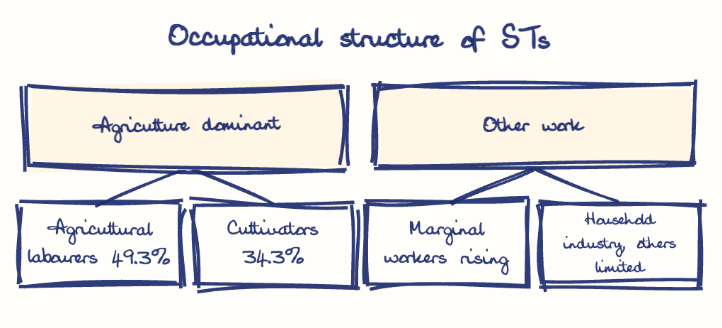
Andhra Pradesh's workforce depends heavily on agriculture, with rising marginal work (20.7%) and little diversification, and among Scheduled Tribes 49.3% are agricultural labourers and 34.3% cultivators. As per the 2001 Census, Scheduled Castes form about 16.2% and Scheduled Tribes about 6.6% of the population, together nearly 23%.
Model answer
Ghissu Editorial · Verified 4 Oct 2026 · 250 words
The occupational structure of Andhra Pradesh21 is predominantly agrarian, with significant SC-ST populations whose inclusion is critical for socio-economic progress. Understanding their occupational patterns and demographic share informs policy interventions like Swarna Andhra Vision 2047.
Occupational Structure and Demographics
1. Agriculture-Centric Workforce: Scheduled Tribes rely heavily on agriculture, with 49.3% as labourers and 34.3% as cultivators, especially in Rayalaseema and coastal districts, indicating limited diversification. 2. SC-ST Population Proportion: Scheduled Tribes form 6.6% of the population (~5 million), concentrated in districts like Khammam and Visakhapatnam; Scheduled Castes form about 16.2% (2001 Census), so SC-STs together are nearly 23% of the population. 3. Gender and Work Participation: ST male and female work participation rates are 55.7% and 52%, respectively, but women often engage in informal, low-paid sectors despite schemes like Mission Shakti.
Economic Vulnerability and Skill Gaps
SC-ST groups face underemployment and limited access to skilled jobs due to educational and infrastructural deficits, including the health infrastructure3 and staff shortfalls flagged by the CAG (2024).
Regional Disparities and Development Plans
Tribal agency areas suffer from poor infrastructure; Swarna Andhra Vision 2047 and schemes like Janani Suraksha Yojana and PMSMA aim to improve health and occupational outcomes.
State Economic Context
Strong state growth has not yet changed the agrarian base of SC-ST livelihoods, so skills and tribal-area infrastructure are needed to make growth inclusive.
This model answer is indicative and the model can make mistakes; please verify key facts independently.
Practise this question
1Get the answer sheet
Sized for this question.
2Write your answer
Timed, by hand.
3Get it marked
Your score and what to fix.
This chapter in the exam
Agriculture Development in Andhra Pradesh31 questions
Asked in 8 of 8 sittings since 2008
Most tested: Agriculture’s structure, performance, and state policy interventions in Andhra Pradesh.
- 2025Discuss the role of agriculture in the economic development of Andhra Pradesh. How has agriculture contributed to the State Gross Domestic Product (SGDP) in recent years? Identify the key drivers influencing its performance.
- 2025What are the key drivers for the growth of the fisheries sector? What are the schemes undertaken by the fisheries department for the growth of this sector?
All 31 questions, sorted by sub-topic, with model answers and practice.
Question from the official APPSC Group-I Mains 2008 paper. Answer written by Ghissu's engine and checked against our editorial standards. Found an error? Tell us and we correct it within 48 hours.