Explain the basic features of Targeted Public Distribution System (TPDS) and its performance in the state.
In short
TPDS gives subsidised grains to BPL and Antyodaya households, with the Centre procuring at MSP and states identifying beneficiaries and running Fair Price Shops, backed legally by the NFSA, 2013. Andhra Pradesh has improved it through digitised ration cards, biometrics and GPS tracking, though bogus cards and storage gaps remain.
Model answer
Ghissu Editorial · Verified 4 Oct 2026 · 261 words
Centre-State3 Cooperation
The central government procures food grains at MSP and allocates them to states, which identify beneficiaries and distribute via Fair Price Shops, enabling state-specific adaptations.
Targeting Challenges
TPDS targets BPL and AAY households but faces 61% exclusion and 25% inclusion errors, undermining effectiveness; Andhra Pradesh combats this with biometric authentication and digitisation.
Leakages and Quality Issues
A large share of grains is diverted to open markets (around 46% leakage nationally, per the Shanta Kumar Committee); CAG audits reveal storage and fund utilisation inefficiencies in Andhra Pradesh, impacting food quality.
Technology-Driven Transparency
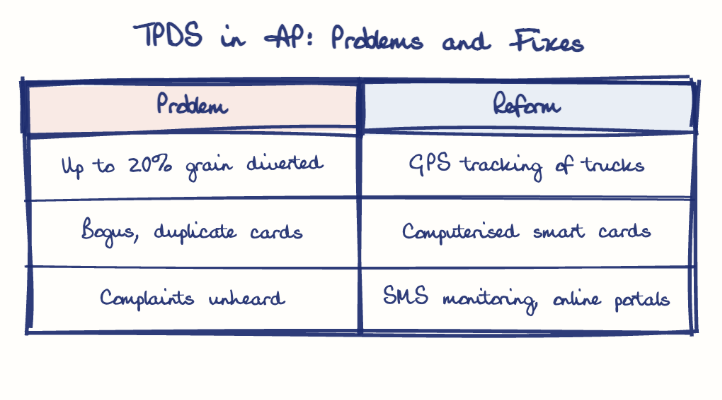
Andhra Pradesh employs GPS tracking, SMS monitoring, and online grievance redressal to reduce leakages and improve accountability.
Strengthen Identification
Periodic verification and Aadhaar integration can eliminate bogus ration cards, improving targeting in Andhra Pradesh.
Infrastructure Investment
Modern storage facilities are needed to reduce spoilage, as highlighted by CAG audits.
Supply Chain Monitoring
Scaling GPS and computerisation across districts can curb diversion risks.
Alternative Delivery Models
Piloting cash transfers or food coupons in Andhra Pradesh may enhance subsidy efficiency and beneficiary choice.
This model answer is indicative and the model can make mistakes; please verify key facts independently.
Practise this question
1Get the answer sheet
Sized for this question.
2Write your answer
Timed, by hand.
3Get it marked
Your score and what to fix.
This chapter in the exam
Inclusive Growth: India and AP schemes49 questions
Asked in 8 of 8 sittings since 2008
Most tested: Women empowerment and poverty reduction through AP welfare and credit-linked institutions
- 2025Elaborate on the meaning of Inclusive Growth in the context of the Indian economy. Discuss the key strategies and instruments that can be employed to foster greater inclusion and ensure that the benefits of economic growth reach all sections of society.
- 2025Critically Examine the major poverty alleviation and employment generation programmes in India. How effective have they been in addressing rural and urban poverty?
All 49 questions, sorted by sub-topic, with model answers and practice.
Question from the official APPSC Group-I Mains 2008 paper. Answer written by Ghissu's engine and checked against our editorial standards. Found an error? Tell us and we correct it within 48 hours.