Explain the methods of measuring unemployment in India.
In short
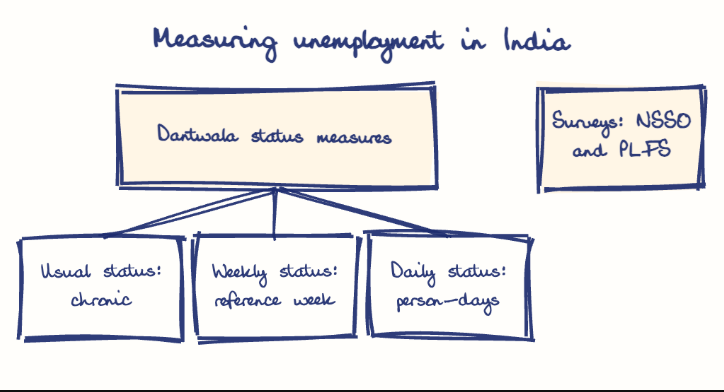
India measures unemployment through NSSO and PLFS surveys using the Dantwala Committee's (1968) approaches: usual status, current weekly status, current daily status and labour time disposition. Estimates range from about 2.2% (usual status) to over 7% (current daily status), as underemployment and informality blur open unemployment.
Model answer
Ghissu Editorial · Verified 4 Oct 2026 · 274 words
Dantwala Committee Methods
The 1968 committee’s four approaches, usual status, current weekly/daily status, labour time disposition, capture long-term and seasonal employment variations, providing nuanced labour utilisation insights.
Labour Bureau and Administrative Data
Labour Bureau’s sectoral reports and efforts to integrate administrative records, including searchable RTI databases in Maharashtra, enhance data transparency, benefiting Andhra Pradesh’s welfare-scheme DBT template. This integration aids timely tracking of employment shifts in industrial corridors like Visakhapatnam.
Underemployment and Variability
High informal sector prevalence obscures unemployment; estimates vary from 2.2% (usual status) to over 7% (current daily status), reflecting definitional and reference period differences.
Economic Shocks
COVID-19 and slowdowns increased unemployment, stressing the need for granular data, especially in drought-hit Rayalaseema, to enable responsive policy measures.
Enhanced Surveys and Data Integration
Increasing survey frequency and linking employment data with administrative records can improve accuracy and reduce reliance on self-reporting, enabling better policy targeting.
Technology and E-Governance
Leveraging digital infrastructure and improving India’s UN E-Government ranking (97th in 2024) can aid real-time employment monitoring in states like Andhra Pradesh, facilitating data-driven governance.
This model answer is indicative and the model can make mistakes; please verify key facts independently.
Practise this question
1Get the answer sheet
Sized for this question.
2Write your answer
Timed, by hand.
3Get it marked
Your score and what to fix.
This chapter in the exam
Major Challenges of Indian Economy26 questions
Asked in 8 of 8 sittings since 2008
Most tested: Unemployment and employment structure
- 2025Discuss how infrastructure bottlenecks hinder the growth of the Indian Manufacturing sector. What steps can be taken to address them?
- 2025Analyse the factors contributing to India's Current Account Deficit (CAD) and unfavourable Balance of Payments (BoP) and discuss their implications for the Indian economy.
All 26 questions, sorted by sub-topic, with model answers and practice.
Question from the official APPSC Group-I Mains 2008 paper. Answer written by Ghissu's engine and checked against our editorial standards. Found an error? Tell us and we correct it within 48 hours.