Explain the role of private sector after economic reforms.
In short
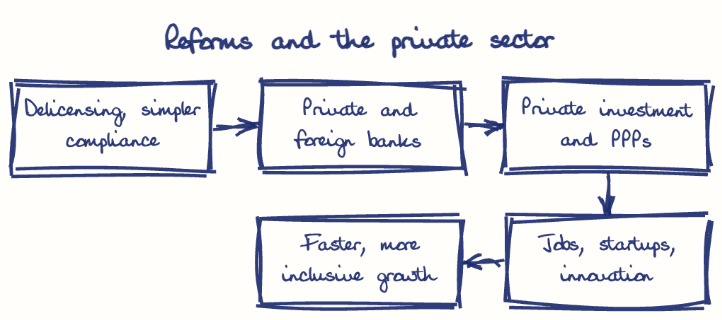
After the 1991 reforms, the private sector became the main driver of India's growth, employment, innovation and infrastructure, entering sectors once reserved for the public sector and complementing it through PPPs. Over 2.23 lakh startups have generated 23.3 lakh direct jobs, showing its employment role.
Model answer
Ghissu Editorial · Verified 4 Oct 2026 · 287 words
Economic Growth Driver
Private sector expansion raised GDP and industrial output, with corporate giants like Tata acquiring Jaguar and Visakhapatnam port-led corridor boosting regional development.
Employment and Innovation
MSMEs and startups, supported by Atal Tinkering Labs and Start-up India, generated millions of jobs; IT hubs such as Hyderabad (in Telangana since 2014) and Andhra Pradesh’s incubation centres foster innovation.
Infrastructure Development
PPPs accelerated projects like Amaravati’s smart city and renewable energy investments in Rayalaseema, enhancing connectivity and sustainability.
Public Sector Complement
Private participation eased public sector burdens, seen in Andhra Pradesh’s power sector reforms.
Financial Sector Reforms
Private and foreign banks increased credit access; ECLGS aided MSMEs, benefiting small businesses in Andhra Pradesh.
Corporate Governance
SEBI mandates on independent directors and CSR enhanced transparency, adopted by Andhra Pradesh companies.
Inclusive Growth
Private investments in Andhra Pradesh’s aquaculture and horticulture improved rural incomes; per capita GDP rose from 34% to 41% of world average (2014-22).
Digitalisation
Platforms like UPI and DBT integrated into Andhra Pradesh’s welfare schemes formalised businesses and boosted financial inclusion.
Sustainable Development
Private green investments, such as solar projects in Andhra Pradesh’s coastal belt, align with climate goals.
This model answer is indicative and the model can make mistakes; please verify key facts independently.
Practise this question
1Get the answer sheet
Sized for this question.
2Write your answer
Timed, by hand.
3Get it marked
Your score and what to fix.
This chapter in the exam
Industrial Development and Policy (India)12 questions
Asked in 5 of 8 sittings since 2008
Most tested: Manufacturing-led industrial policy reform and its policy instruments.
- 2025Discuss the role of the industrial sector in the economic development of India. Discuss the role of the Department of Industrial Policy & Promotion (DIPP).
- 2025Examine the role of the industrial sector in India's economic development. How does industrialisation contribute to income generation, employment, and modernisation of the economy? Support your answer with relevant examples and policy references.
All 12 questions, sorted by sub-topic, with model answers and practice.
Question from the official APPSC Group-I Mains 2008 paper. Answer written by Ghissu's engine and checked against our editorial standards. Found an error? Tell us and we correct it within 48 hours.