What is Green Revolution? What is its impact on the agricultural economy of Andhra Pradesh?
In short
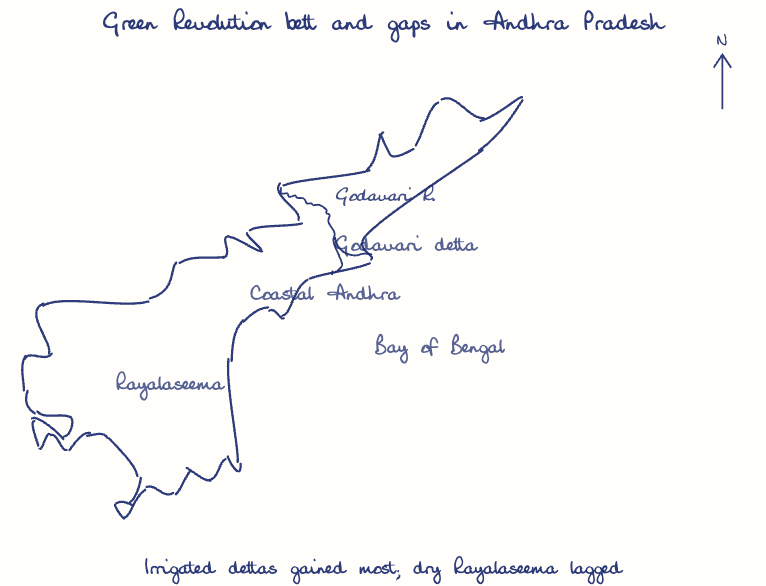
The Green Revolution of the 1960s and 1970s raised foodgrain output through high-yielding seeds, chemical fertilisers and irrigation, and in Andhra Pradesh it sharply increased rice yields in irrigated coastal districts like West Godavari. Its gains bypassed drought-prone Rayalaseema and small farmers, while heavy chemical use degraded soil and groundwater.
Model answer
Ghissu Editorial · Verified 4 Oct 2026 · 246 words
Irrigated Coastal Focus
The revolution was concentrated in well-irrigated districts like West Godavari, enabling HYV rice cultivation and reflecting national trends.
Research and Extension
Acharya N.G. Ranga Agricultural University and government schemes such as the Intensive Agriculture Development Programme (IADP) supported technology dissemination and farmer training.
Agricultural Growth and Disparities
Rice yields surged, laying the base of a farm sector that still grows fast (10.7% agricultural GVA growth in Andhra Pradesh in 2024-25), but small and marginal farmers, especially in Rayalaseema, faced limited access to inputs and credit.
Environmental and Market Issues
Intensive chemical use caused soil degradation and groundwater depletion; inadequate post-harvest infrastructure constrained farmer incomes, leading to initiatives like AP Community Managed Natural Farming (APCNF).
Sustainable Practices and Credit Access
Scaling APCNF and improving rural credit through schemes like Kisan Credit Cards can promote equity and environmental health.
Infrastructure and Climate Resilience
Investing in storage and drought-resistant technologies is crucial for vulnerable regions.
This model answer is indicative and the model can make mistakes; please verify key facts independently.
Practise this question
1Get the answer sheet
Sized for this question.
2Write your answer
Timed, by hand.
3Get it marked
Your score and what to fix.
This chapter in the exam
Agricultural Development (India)16 questions
Asked in 7 of 8 sittings since 2008
Most tested: Agricultural credit and market regulation/price policy.
- 2025Examine the significance of agriculture finance, production, and marketing in the context of India's agricultural development. Discuss the challenges and opportunities associated with financing agricultural activities, improving production, and developing efficient marketing systems to support sustainable growth in the agricultural sector.
- 2025Explain the role of the Agricultural Produce Market Committee (APMC) Act in Agricultural Price Policy in regulating the agricultural market in India. What are the issues that have been observed by policy makers regarding the functioning of the APMC Act?
All 16 questions, sorted by sub-topic, with model answers and practice.
Question from the official APPSC Group-I Mains 2008 paper. Answer written by Ghissu's engine and checked against our editorial standards. Found an error? Tell us and we correct it within 48 hours.