Why are Land Reforms implemented? What are the main laws pertaining to Land Reforms in Andhra Pradesh?
In short
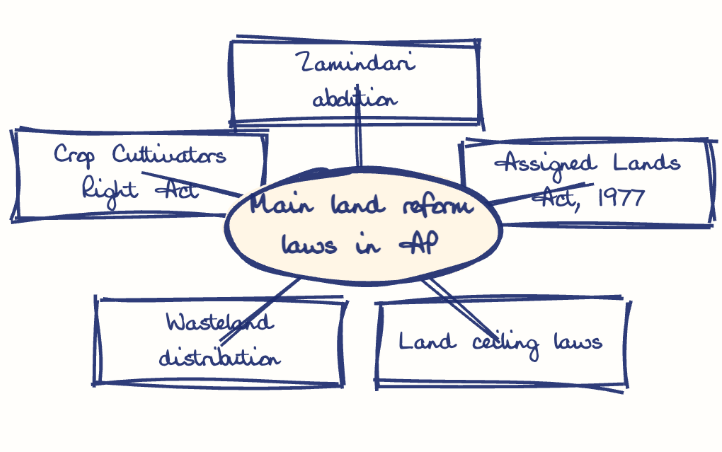
Land reforms are implemented to end intermediaries, cap landholdings, protect tenants and redistribute land to the landless, reducing rural poverty and inequality. Andhra Pradesh's main laws include the Andhra Area Tenancy Act 1956, the Land Reforms (Ceiling) Act 1973 and the Assigned Lands (Prohibition of Transfers) Act 1977.
Model answer
Ghissu Editorial · Verified 4 Oct 2026 · 235 words
Pioneering Land Reforms
Andhra Pradesh was an early adopter, abolishing zamindari intermediaries and implementing the Assigned Lands (Prohibition of Transfers) Act, 1977, to secure Dalit land rights; however, 2023 amendments relaxed these protections, sparking controversy.
Land Ceiling and Redistribution
The state enforces land ceilings, redistributing surplus and wasteland as house sites or agricultural land to the rural poor, aiding poverty reduction and social equity.
Administrative and Legal Barriers
Prolonged litigation, bureaucratic delays, and vested interests of landlords and moneylenders hinder reforms, while gaps in land records weaken enforcement of ceiling and tenancy laws.
Controversies and Policy Reversals
Recent laws easing assigned land sales risk reversing gains for Dalits, raising fears of feudal resurgence and necessitating stronger safeguards.
Strengthen Safeguards and Transparency
Reinforce laws protecting assigned lands, enhance land record management, and involve communities in monitoring land use.
Integrate with Agricultural Support
Link reforms with schemes like Crop Cultivators Right Act4, AP Community Managed Natural Farming (APCNF) and Annadatha Sukhibhava to boost farmer incomes and sustainability.
This model answer is indicative and the model can make mistakes; please verify key facts independently.
Practise this question
1Get the answer sheet
Sized for this question.
2Write your answer
Timed, by hand.
3Get it marked
Your score and what to fix.
This chapter in the exam
Agriculture Development in Andhra Pradesh31 questions
Asked in 8 of 8 sittings since 2008
Most tested: Agriculture’s structure, performance, and state policy interventions in Andhra Pradesh.
- 2025Discuss the role of agriculture in the economic development of Andhra Pradesh. How has agriculture contributed to the State Gross Domestic Product (SGDP) in recent years? Identify the key drivers influencing its performance.
- 2025What are the key drivers for the growth of the fisheries sector? What are the schemes undertaken by the fisheries department for the growth of this sector?
All 31 questions, sorted by sub-topic, with model answers and practice.
Question from the official APPSC Group-I Mains 2008 paper. Answer written by Ghissu's engine and checked against our editorial standards. Found an error? Tell us and we correct it within 48 hours.