Define fermentation. Discuss the general procedure for the production of alcohol in the industry.
In short
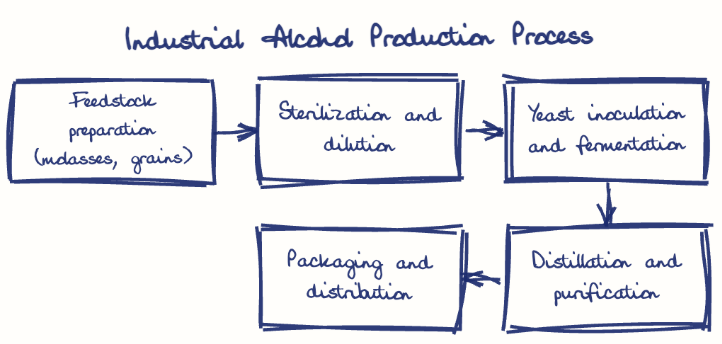
Fermentation is the enzymatic breakdown of organic substances by microorganisms, chiefly yeasts like Saccharomyces cerevisiae, converting sugars into alcohol and carbon dioxide. Industrial alcohol production prepares feedstocks such as molasses or grains, sterilises and dilutes them, inoculates yeast to ferment, then distils and purifies the alcohol.
Model answer
Ghissu Editorial · Verified 4 Oct 2026 · 296 words
Government Incentives
The Government of India promotes ethanol through the 2014 administered pricing mechanism and DFPD interest subvention schemes, expanding distillery capacity. In Andhra Pradesh, these policies have boosted molasses and grain-based distilleries, leveraging local agro-resources.
Regulatory Clarity and Quality Standards
The Supreme Court’s nine-judge bench ruling in 2024 that states can regulate industrial alcohol as 'intoxicating liquor' provided clarity on the regulation of alcohol production. Additionally, FSSAI reforms have eased licensing for fermentation enterprises, benefiting small and medium producers in Andhra Pradesh.
Consumer Concerns and Transition
Ethanol-blended fuel policies raise consumer and environmental issues; the sector is moving towards methanol, ethanol, hydrogen fuels, and fuel efficiency labeling to address sustainability and market demands. In Andhra Pradesh, climatic and feedstock variability require adaptive fermentation management.
Policy and Innovation
The High-Level Committee on Non-Financial Regulatory Reforms2 recommends streamlining regulations; advancing yeast strain R&D at institutes like CFTRI and upgrading infrastructure in Andhra Pradesh can enhance production efficiency and quality.
Sustainability Focus
Ethanol production helps manage excess sugarcane and reduce imports, aligning with energy security, rural development, and the National Bio-Energy Mission’s goals.
This model answer is indicative and the model can make mistakes; please verify key facts independently.
Practise this question
1Get the answer sheet
Sized for this question.
2Write your answer
Timed, by hand.
3Get it marked
Your score and what to fix.
This chapter in the exam
Biotechnology & Nanotechnology: scope, ethics, genetic engineering, biodiversity, fermentation, immuno-diagnosis50 questions
Asked in 8 of 8 sittings since 2008
Most tested: Biodiversity and biotechnology governance/ethics, especially conservation, GMOs, and applied public-health biotech.
- 2025Trace the evolution of India's National Biotechnology Development Strategy (NBDS) and discuss its key objectives. Critically evaluate its impact on the growth of the biotechnology sector in India.
- 2025Analyze the potential of plant-derived biopharmaceuticals in promoting sustainable healthcare. Explain how the application of green pharmacy principles can help minimize environmental harm at each stage of the pharmaceutical lifecycle.
All 50 questions, sorted by sub-topic, with model answers and practice.
Question from the official APPSC Group-I Mains 2008 paper. Answer written by Ghissu's engine and checked against our editorial standards. Found an error? Tell us and we correct it within 48 hours.