(i) Explain the effects of air pollution. (ii) Suggest various measures to control air pollution.
In short
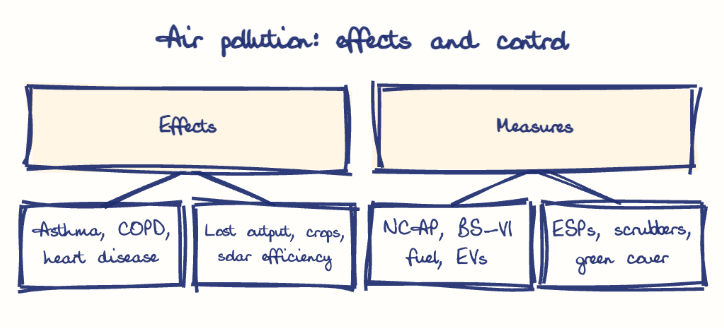
Air pollution causes asthma, COPD and heart disease, lowers productivity, damages crops and ecosystems through acid rain, and even cuts solar panel efficiency. It can be controlled through the National Clean Air Programme, BS-VI fuel and electric vehicles under FAME-II, electrostatic precipitators and scrubbers in industry, zoning and public awareness.
Model answer
Ghissu Editorial · Verified 4 Oct 2026 · 260 words
Vehicular Emissions
Vehicular emissions are the primary source of Delhi’s air pollution, releasing particulate matter and nitrogen oxides that intensify winter smog and respiratory illnesses. The adoption of Bharat Stage VI fuel standards aims to curb these emissions but enforcement remains a challenge.
Health and Economic Impact
Air pollution causes respiratory and cardiovascular diseases, contributing to millions of deaths globally; reducing pollution yields tangible health3 benefits and economic savings. Studies show that pollution-related illnesses reduce worker productivity and increase healthcare costs, straining the economy.
Policy Gaps
Delhi’s recurring winter smog reveals gaps in enforcement of emission standards and urban planning, exacerbating pollution levels despite existing regulations. Lack of coordination among agencies and inadequate public awareness worsen the situation.
Government Measures
The National Clean Air Programme (NCAP) targets a 40% reduction in particulate matter by 2025-26; promotion of electric vehicles and cleaner fuels under schemes like FAME-II are key steps. Additionally, initiatives like odd-even vehicle rationing and expansion of public transport aim to reduce vehicular pollution.
This model answer is indicative and the model can make mistakes; please verify key facts independently.
Practise this question
1Get the answer sheet
Sized for this question.
2Write your answer
Timed, by hand.
3Get it marked
Your score and what to fix.
This chapter in the exam
Pollution & solid waste; global issues; environmental legislation; disaster management policy; agricultural revolutions43 questions
Asked in 8 of 8 sittings since 2008
Most tested: Solid waste management and pollution-control legislation
- 2025What are the key principles of Integrated Solid Waste Management (ISWM)? Discuss the role of waste hierarchy in ISWM.
- 2025Define global warming, and differentiate it clearly from climate change. Explain the key natural and human-induced causes of global warming and briefly discuss which factors are currently dominant in driving global temperature rise.
All 43 questions, sorted by sub-topic, with model answers and practice.
Question from the official APPSC Group-I Mains 2008 paper. Answer written by Ghissu's engine and checked against our editorial standards. Found an error? Tell us and we correct it within 48 hours.