What are the key principles of Integrated Solid Waste Management (ISWM)? Discuss the role of waste hierarchy in ISWM.
In short
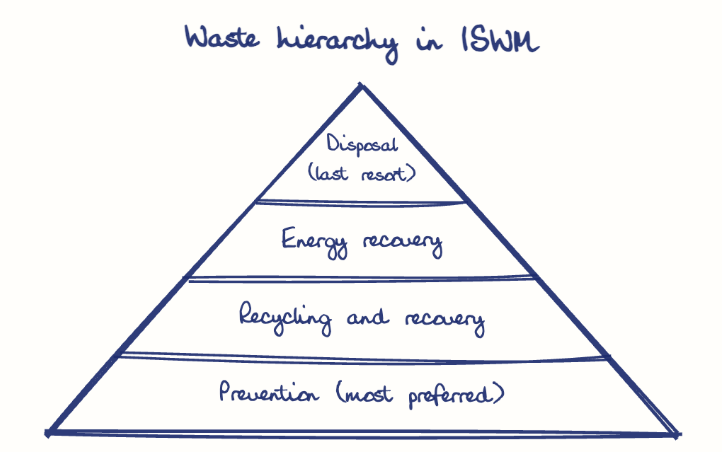
Integrated Solid Waste Management combines segregation, collection, processing and disposal with institutional capacity, regulation, stakeholder participation and reliable data, backed by the 2016 Solid Waste Management Rules and Extended Producer Responsibility. The waste hierarchy guides it: prevent first, then reuse, recycle and recover energy, with landfilling only for residue.
Model answer
Ghissu Editorial · Verified 4 Oct 2026 · 266 words
Multi-tier Governance and Legal Support
ISWM requires coordination among central, state, and local bodies; the 2016 Solid Waste Management Rules, Swachh Bharat Mission2 (Urban), and Extended Producer Responsibility (EPR) guidelines3 provide regulatory backing. Andhra Pradesh’s 2022 audit found only 5 of 17 ULBs had bye-laws aligned with SWM Rules, showing institutional gaps.
Capacity Building and Data Monitoring
Training municipal staff and integrating informal waste pickers, who collect over 10,000 tonnes daily nationally, are crucial; however, Andhra Pradesh’s segregation rates were overstated (claimed 98.17%4, actual ~75%), indicating weak monitoring.
Infrastructure Deficits
82 of 123 ULBs in Andhra Pradesh lacked wet waste processing plants, and only 4 had sanitary landfills in 2022, forcing reliance on harmful open dumpsites.
Prioritising Prevention and Recycling
Waste minimisation and reuse reduce environmental impact; ISWM integrates informal sector recycling to maximise resource recovery.
Energy Recovery and Disposal
Waste-to-energy reduces landfill volume but requires pollution control; landfilling is last resort for inert waste.
This model answer is indicative and the model can make mistakes; please verify key facts independently.
Practise this question
1Get the answer sheet
Sized for this question.
2Write your answer
Timed, by hand.
3Get it marked
Your score and what to fix.
This chapter in the exam
Pollution & solid waste; global issues; environmental legislation; disaster management policy; agricultural revolutions43 questions
Asked in 8 of 8 sittings since 2008
Most tested: Solid waste management and pollution-control legislation
- 2025Define global warming, and differentiate it clearly from climate change. Explain the key natural and human-induced causes of global warming and briefly discuss which factors are currently dominant in driving global temperature rise.
- 2025Discuss the role of remote sensing in tracking the dispersion of environmental pollutants. Analyze its implications for human health in affected regions, highlighting limitations and future improvements.
All 43 questions, sorted by sub-topic, with model answers and practice.
Question from the official APPSC Group-I Mains 2025 paper. Answer written by Ghissu's engine and checked against our editorial standards. Found an error? Tell us and we correct it within 48 hours.