(i) What do you understand by the term ecosystem ? (ii) Write the structure of ecosystem. (iii) List out different types of aquatic ecosystems existing in India. (iv) What are the threats to aquatic ecosystems and how can they be conserved ?
In short
An ecosystem is a functional unit of biotic components (producers, consumers, decomposers) and abiotic factors, and India's aquatic ecosystems are freshwater, brackish and marine, including coral reefs. Facing pollution, habitat loss, overfishing and climate change, they are conserved through the NPCA, Wetlands Rules 2017, CRZ rules and mangrove restoration.
Model answer
Ghissu Editorial · Verified 4 Oct 2026 · 293 words
Ecosystem Defined
A functional unit of interacting organisms and their physical environment, forming a dynamic complex.
Components
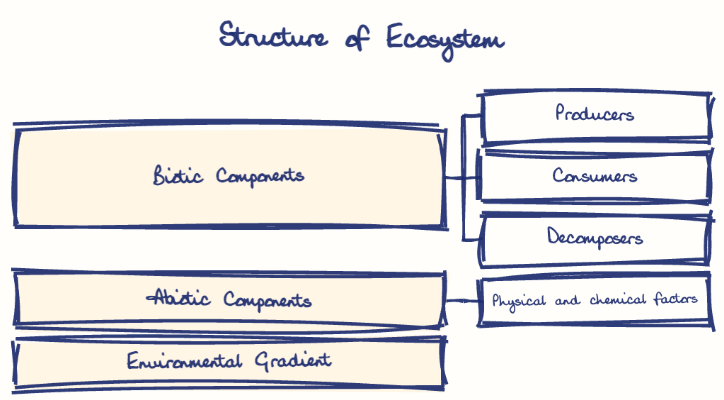
Biotic (producers, consumers, decomposers) and abiotic (light, temperature, nutrients) factors shape ecosystem dynamics.
Environmental Gradient
Variations in temperature, moisture, and light influence species distribution and ecosystem functioning.
Types
Freshwater (rivers like Krishna and Godavari), marine (coastline including Visakhapatnam), brackish water (mangroves in Godavari delta), and coral reefs (Gulf of Mannar, Andaman Islands).
Ecological Importance
These ecosystems support biodiversity, livelihoods, and the Blue Economy, which contributes significantly to India’s GDP and employment.
Threats
Pollution from industrial effluents and agricultural runoff, habitat loss due to encroachment, overfishing, and climate change disrupt aquatic ecosystems.
Conservation Efforts
National Plan for Conservation of Aquatic Eco-systems (NPCA), Wetlands (Conservation and Management) Rules 2017, community roles via Biodiversity Management Committees2, mangrove restoration in Godavari-Krishna delta, and Coastal Regulation Zone (CRZ) enforcement.
Community Participation
Involving local stakeholders through People’s Biodiversity Registers enhances sustainable management and monitoring.
Challenges
Resource limits, fragmented governance, and low public awareness hinder effective conservation.
Positive Outcomes
Increased mangrove cover and Ramsar site expansions demonstrate progress in ecosystem resilience and biodiversity protection.
This model answer is indicative and the model can make mistakes; please verify key facts independently.
Practise this question
1Get the answer sheet
Sized for this question.
2Write your answer
Timed, by hand.
3Get it marked
Your score and what to fix.
This chapter in the exam
Biotechnology & Nanotechnology: scope, ethics, genetic engineering, biodiversity, fermentation, immuno-diagnosis50 questions
Asked in 8 of 8 sittings since 2008
Most tested: Biodiversity and biotechnology governance/ethics, especially conservation, GMOs, and applied public-health biotech.
- 2025Trace the evolution of India's National Biotechnology Development Strategy (NBDS) and discuss its key objectives. Critically evaluate its impact on the growth of the biotechnology sector in India.
- 2025Analyze the potential of plant-derived biopharmaceuticals in promoting sustainable healthcare. Explain how the application of green pharmacy principles can help minimize environmental harm at each stage of the pharmaceutical lifecycle.
All 50 questions, sorted by sub-topic, with model answers and practice.
Question from the official APPSC Group-I Mains 2008 paper. Answer written by Ghissu's engine and checked against our editorial standards. Found an error? Tell us and we correct it within 48 hours.