(i) What is a low volume, high value product in biotechnology ? (ii) Write about interferons, their applications and a general scheme for the industrial production of interferons.
In short
Low volume, high value biotech products are specialised biomolecules such as recombinant proteins, monoclonal antibodies and interferons, made in small quantities but commanding high prices. Interferons, signalling proteins used against hepatitis and some cancers, are produced by cloning their genes into bacterial or mammalian cells, fermentation and chromatographic purification.
Model answer
Ghissu Editorial · Verified 4 Oct 2026 · 258 words
Definition and Importance
These are specialized biopharmaceuticals such as recombinant proteins and monoclonal antibodies produced in limited quantities but with high market value and therapeutic impact.
Challenges and Strategic Role
High R&D costs and regulatory hurdles limit scale, but these products reduce import dependence, exemplified by DNA vaccines like ZyCoV-D developed under BIRAC.
Types and Functions
Interferons (alpha, beta, gamma) are proteins that modulate immune responses against viruses, cancers, and autoimmune diseases.
Biomedical Uses and Synthetic Vaccines
Used in hepatitis and melanoma treatment, interferons’ efficacy is enhanced by synthetic vaccines developed with monoclonal antibodies, supported by Andhra Pradesh’s research institutions.
Recombinant Technology and Fermentation
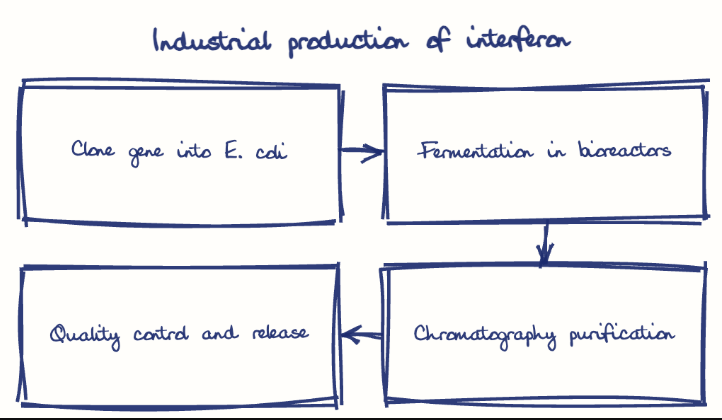
Interferon genes are cloned into host cells like E. coli, cultured in bioreactors, and purified via chromatography.
Quality and Innovation
Production adheres to strict regulatory standards monitored by the Central Drugs Standard Control Organization, with advances supported by schemes like Bio-RIDE and the PLI Scheme in Visakhapatnam’s pharmaceutical clusters.
Ecosystem Strengthening
Expand incubation centres and PPPs involving BIRAC to enhance R&D and commercialization.
Manufacturing and Regulation
Invest in advanced bioprocessing and streamline approvals while developing skilled biotech workforce.
This model answer is indicative and the model can make mistakes; please verify key facts independently.
Practise this question
1Get the answer sheet
Sized for this question.
2Write your answer
Timed, by hand.
3Get it marked
Your score and what to fix.
This chapter in the exam
Biotechnology & Nanotechnology: scope, ethics, genetic engineering, biodiversity, fermentation, immuno-diagnosis50 questions
Asked in 8 of 8 sittings since 2008
Most tested: Biodiversity and biotechnology governance/ethics, especially conservation, GMOs, and applied public-health biotech.
- 2025Trace the evolution of India's National Biotechnology Development Strategy (NBDS) and discuss its key objectives. Critically evaluate its impact on the growth of the biotechnology sector in India.
- 2025Analyze the potential of plant-derived biopharmaceuticals in promoting sustainable healthcare. Explain how the application of green pharmacy principles can help minimize environmental harm at each stage of the pharmaceutical lifecycle.
All 50 questions, sorted by sub-topic, with model answers and practice.
Question from the official APPSC Group-I Mains 2008 paper. Answer written by Ghissu's engine and checked against our editorial standards. Found an error? Tell us and we correct it within 48 hours.