What are the outcomes of crop science research in India ?
In short
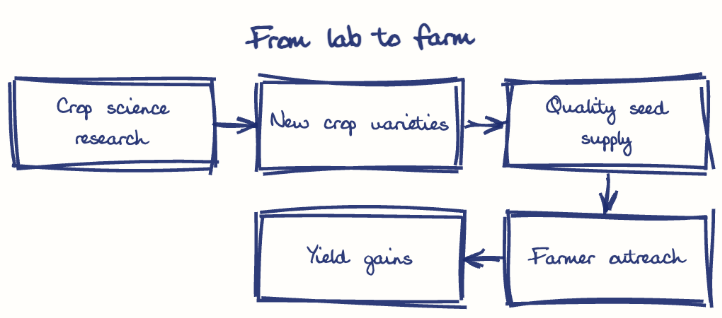
Crop science research in India has produced over 100 ICAR varieties for diverse agro-ecological zones, quality breeder seed and precision tools like micro-irrigation and drones, raising yields and resilience. Landmark outcomes include the drought-tolerant chickpea SAATVIK and India's first genome-edited rice varieties, though weak extension slows adoption.
Model answer
Ghissu Editorial · Verified 4 Oct 2026 · 274 words
Robust Research Infrastructure
ICAR’s development of 100+ crop varieties tailored to agro-ecological zones supports yield and stress tolerance, benefiting Andhra Pradesh.
Seed Production and Quality Control
Production of 11,800+ tonnes of breeder seeds ensures availability of quality seeds, aiding adoption of improved varieties.
Policy and Regulatory Frameworks
The Environment (Protection) Act, 1986, and gene-editing guidelines enable safe commercialization of molecular breeding products in rice, wheat, and cotton.
Public-Private Collaboration
Partnerships with private sector and global tech access help bridge innovation gaps despite IPR and investment challenges.
Adoption and Farmer Outreach
Over 10,000 farmers trained, but adoption remains modest due to extension gaps, notably in Andhra Pradesh.
Yield and Productivity Gains
Drought-tolerant chickpea SAATVIK and India's first genome-edited rice varieties, released in 2025, promise higher productivity.
Technological Innovations
Micro-irrigation, precision farming, and drone pest management (e.g., 2020 locust control) improve resource efficiency.
Challenges in Scaling
Funding constraints and fragmented efforts limit innovation diffusion; Andhra Pradesh faces infrastructural bottlenecks.
Increase R&D Investment
Boost funding for crop science with centers of excellence to drive innovation.
Strengthen Extension
Expand farmer training and ICT use to improve adoption in Andhra Pradesh.
Promote Public-Private Partnerships
Supportive IPR policies to ease access to global germplasm and biotech innovations.
Integrate Sustainable Practices
Encourage resource conservation and integrated crop management.
This model answer is indicative and the model can make mistakes; please verify key facts independently.
Sources
Practise this question
1Get the answer sheet
Sized for this question.
2Write your answer
Timed, by hand.
3Get it marked
Your score and what to fix.
This chapter in the exam
Pollution & solid waste; global issues; environmental legislation; disaster management policy; agricultural revolutions43 questions
Asked in 8 of 8 sittings since 2008
Most tested: Solid waste management and pollution-control legislation
- 2025What are the key principles of Integrated Solid Waste Management (ISWM)? Discuss the role of waste hierarchy in ISWM.
- 2025Define global warming, and differentiate it clearly from climate change. Explain the key natural and human-induced causes of global warming and briefly discuss which factors are currently dominant in driving global temperature rise.
All 43 questions, sorted by sub-topic, with model answers and practice.
Question from the official APPSC Group-I Mains 2008 paper. Answer written by Ghissu's engine and checked against our editorial standards. Found an error? Tell us and we correct it within 48 hours.