What are the various renewable energy resources ? What is their potential in our country ?
In short
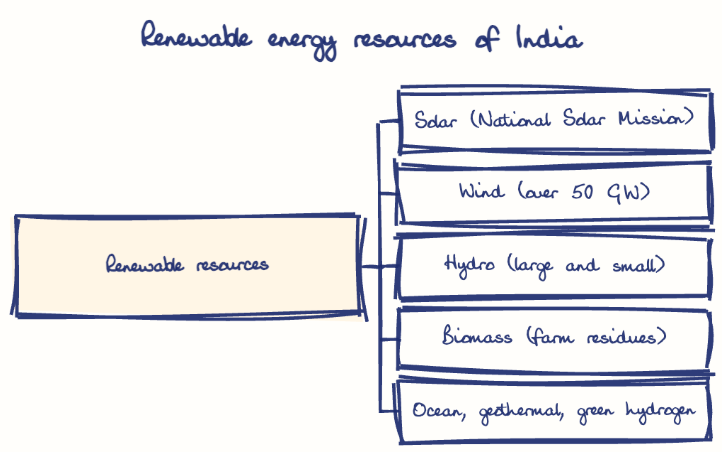
India's renewable energy resources include solar, wind, hydro, biomass, ocean, geothermal and green hydrogen, and their potential is vast. Estimates put solar potential at about 748 GW and wind at about 695 GW at 120 m hub height, underpinning the 500 GW non-fossil target for 2030.
Model answer
Ghissu Editorial · Verified 4 Oct 2026 · 267 words
Governance and Legal Framework
MNRE leads policy with IREDA financing projects; Electricity Act 2003 and National Tariff Policy 2006 mandate Renewable Purchase Obligations and tariff regulations.
Resource Potential and Infrastructure
India’s renewable mix includes solar (over 100 GW installed against a potential of about 748 GW), wind (50+ GW installed), hydro, biomass, and green hydrogen; Andhra Pradesh’s 974 km coastline offers vast wind and solar potential, but grid integration challenges persist despite Green Energy Corridor efforts.
Financial Barriers and Rural Benefits
Financing gaps remain despite falling solar tariffs; Production Linked Incentive (PLI) schemes encourage private investment. PM-KUSUM solar pumps improve agricultural productivity in Rayalaseema, reducing diesel use.
Environmental Impact and Scalability
Renewables cut emissions and pollution, aiding climate goals; energy storage and demand management are needed to handle variability.
Enhance State Capacity and Finance
Strengthen Andhra Pradesh’s project approvals and grid integration; expand affordable credit via PLI and IREDA.
Promote Rural Adoption and R&D
Scale PM-KUSUM and rooftop solar in rural areas; invest in indigenous tech and storage solutions.
This model answer is indicative and the model can make mistakes; please verify key facts independently.
Practise this question
1Get the answer sheet
Sized for this question.
2Write your answer
Timed, by hand.
3Get it marked
Your score and what to fix.
This chapter in the exam
Energy: needs, resources, policy; Nuclear programme and policy24 questions
Asked in 8 of 8 sittings since 2008
Most tested: Renewable energy transition in India, especially solar/clean energy and barriers to large-scale adoption.
- 2025Differentiate between conventional and non-conventional energy resources. Explain their relevance in India's energy sector.
- 2023What is the current scenario of renewable power generation in India ? Discuss the factors responsible for the growing focus and shift towards Renewable energy.
All 24 questions, sorted by sub-topic, with model answers and practice.
Question from the official APPSC Group-I Mains 2008 paper. Answer written by Ghissu's engine and checked against our editorial standards. Found an error? Tell us and we correct it within 48 hours.