Write about the role of biotechnology in environmental clean-up processes.
In short
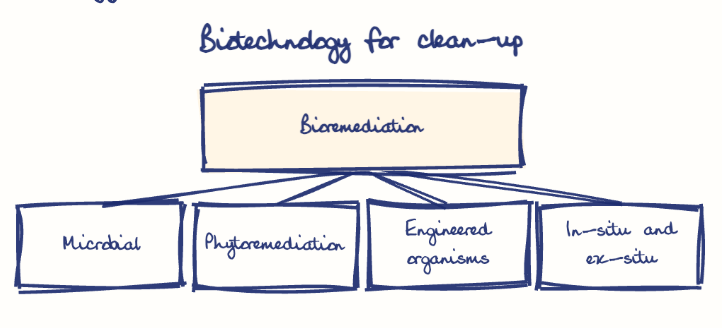
Biotechnology cleans the environment through microbial bioremediation that degrades pollutants, phytoremediation that pulls heavy metals from soil and water, engineered organisms and biogas plants that turn waste into energy. Backed by the BioE3 Policy and Bio-RIDE, it can make pollution control cheaper and greener, though scale-up and biosafety remain hurdles.
Model answer
Ghissu Editorial · Verified 4 Oct 2026 · 250 words
Phytoremediation and Genetic Engineering
Plants absorb contaminants, while genetically engineered bacteria serve as bioindicators emitting bioluminescence to detect toxins. Genetic engineering enhances pollutant targeting, improving monitoring and clean-up precision.
Waste Management
CSIR’s IHBT, Palampur (Himachal Pradesh), developed portable biogas plants converting food waste into energy, a model Andhra Pradesh’s towns could adopt to reduce landfill burden. Anaerobic digestion also produces organic manure, promoting circular waste use.
Water and Soil Remediation
CPCB’s BOD-based1 river pollution mapping guides biotechnological interventions, especially in Andhra Pradesh’s coastal zones where aquaculture depends on water quality. Bioremediation reduces organic and heavy metal pollution, safeguarding ecosystems and livelihoods.
Plastic Recycling and Bio-based Materials
Enzymatic degradation and bio-polymers reduce plastic pollution and fossil fuel dependence, aligning with BioE3 goals. These innovations promote circular economy models by converting plastics into fuels or biodegradable alternatives.
Economic Barriers and Innovation
High costs and infrastructure gaps exist, especially in rural Andhra Pradesh, but Bio-RIDE fosters R&D, entrepreneurship, and skilled employment, accelerating indigenous technology development.
This model answer is indicative and the model can make mistakes; please verify key facts independently.
Sources
Practise this question
1Get the answer sheet
Sized for this question.
2Write your answer
Timed, by hand.
3Get it marked
Your score and what to fix.
This chapter in the exam
Biotechnology & Nanotechnology: scope, ethics, genetic engineering, biodiversity, fermentation, immuno-diagnosis50 questions
Asked in 8 of 8 sittings since 2008
Most tested: Biodiversity and biotechnology governance/ethics, especially conservation, GMOs, and applied public-health biotech.
- 2025Trace the evolution of India's National Biotechnology Development Strategy (NBDS) and discuss its key objectives. Critically evaluate its impact on the growth of the biotechnology sector in India.
- 2025Analyze the potential of plant-derived biopharmaceuticals in promoting sustainable healthcare. Explain how the application of green pharmacy principles can help minimize environmental harm at each stage of the pharmaceutical lifecycle.
All 50 questions, sorted by sub-topic, with model answers and practice.
Question from the official APPSC Group-I Mains 2008 paper. Answer written by Ghissu's engine and checked against our editorial standards. Found an error? Tell us and we correct it within 48 hours.