Bring out the salient features of the Indus and Vedic Civilizations in a comparative perspective.
In short
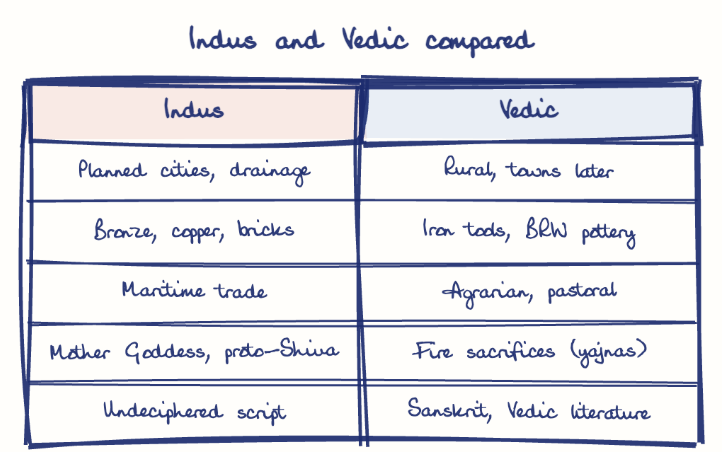
The Indus Civilization was highly urban, with grid-planned cities, drainage, standardised bricks, bronze tools, maritime trade and an undeciphered script, whereas the Vedic Civilization began rural and pastoral, with a varna-based society, fire sacrifices and Sanskrit literature. Later Vedic times introduced iron tools and towns like Kaushambi.
Model answer
Ghissu Editorial · Verified 4 Oct 2026 · 276 words
Advanced Urban Planning
Cities like Harappa and Mohenjo-daro had grid layouts, citadel-residential separation, and sophisticated drainage systems reflecting high civic organization.
Trade and Cultural Symbols
Lothal’s port facilitated maritime trade with Mesopotamia; artifacts show worship of Mother Goddess and proto-Shiva, with an undeciphered script indicating complex administration.
Rural Society and Social Stratification
Early Vedic society was pastoral and agrarian, organized into varnas with Brahminical dominance and fire sacrifices (yajnas) as central rituals.
Technological and Urban Development
Iron1 tools emerged later, enhancing agriculture and warfare; towns like Kaushambi appeared without Indus-style planning but marked political complexity.
Urbanisation and Economy
The Indus Civilization was highly urban and trade-oriented with maritime links, while Vedic society was initially rural and agro-pastoral, with towns emerging only later.
Language and Religion
Indus script remains undeciphered and non-Sanskrit; Vedic Sanskrit literature flourished, evolving from ritualistic fire sacrifices to Bhakti cults venerating Vishnu and Shiva.
Archaeological Research
Greater funding and technology in excavations can help decode the Indus script and clarify cultural continuity.
Heritage and Education
Conserving Indus and Vedic sites and including both phases in curricula can foster appreciation of India’s layered heritage.
This model answer is indicative and the model can make mistakes; please verify key facts independently.
Sources
Practise this question
1Get the answer sheet
Sized for this question.
2Write your answer
Timed, by hand.
3Get it marked
Your score and what to fix.
This chapter in the exam
Ancient India - Pre-history, IVC, Vedic, Mauryas, Kushans, Satavahanas, Sangam, Guptas16 questions
Asked in 8 of 8 sittings since 2008
Most tested: Harappan civilisation—urban planning, origin/decline, and continuity.
- 2025Discuss the origin and expansion of the Indus Valley Civilization.
- 2025Briefly analyze the teachings of Buddha and Mahavira.
All 16 questions, sorted by sub-topic, with model answers and practice.
Question from the official APPSC Group-I Mains 2011 paper. Answer written by Ghissu's engine and checked against our editorial standards. Found an error? Tell us and we correct it within 48 hours.