Critically examine the role of Socialists and Communists in the Freedom Movements in Andhra Desha between the years 1935-1947.
In short
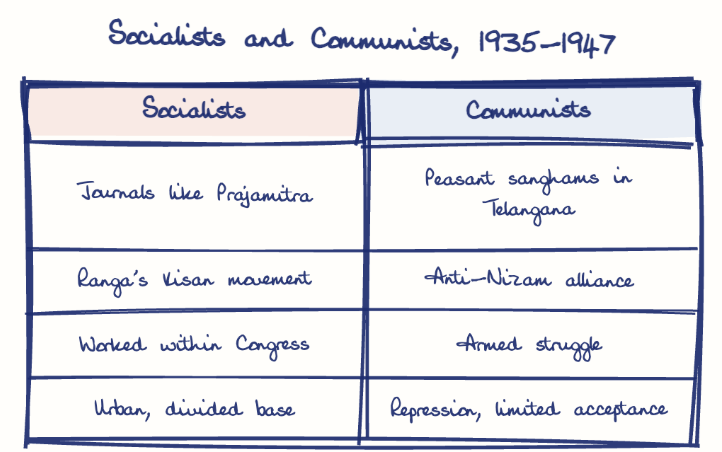
Between 1935 and 1947 Socialists like N G Ranga organised Kisan movements in coastal Andhra and led much of Quit India's underground phase, while Communists built peasant sanghams in Telangana against vetti, leading to the Telangana Armed Struggle. Divisions, narrow bases, the Communists' People's War line and repression limited both.
Model answer
Ghissu Editorial · Verified 4 Oct 2026 · 283 words
Congress Participation and Limitations
Socialists worked within Congress and Quit India Movement, pushing for radical reforms, but struggled to build a mass base beyond urban intellectuals. Internal divisions and limited rural penetration weakened their organizational strength in Andhra Desha.
Grassroots Mobilization and Telangana Armed Struggle1
Communists organized peasants into sanghams resisting bonded labour, forced grain levies, and illegal evictions, culminating in the Telangana Armed Struggle, India’s first major peasant guerrilla movement challenging feudal oppression.
Political Alliances and Cadre Building
They allied with Andhra Mahasabha and Hyderabad State Congress against the Nizam’s autocratic rule, with leaders like Ravi Narayana Reddi and Chandra Rajeswara Rao. Their cadre-building through political schools and the Comrades Association sustained prolonged resistance despite bans and repression.
Impact on Agrarian Rights and Nationalism
Both Socialists and Communists advanced peasants’ and workers’ rights, challenging feudal exploitation and colonial economic structures. The Communists’ role in anti-Nizam struggles was crucial for Hyderabad’s integration into India, while Socialists broadened nationalist campaigns like Quit India.
This model answer is indicative and the model can make mistakes; please verify key facts independently.
Sources
Practise this question
1Get the answer sheet
Sized for this question.
2Write your answer
Timed, by hand.
3Get it marked
Your score and what to fix.
This chapter in the exam
Andhra - Nationalist Movement and Formation of the State22 questions
Asked in 8 of 8 sittings since 2008
Most tested: Formation of Andhra Pradesh and the Andhra-Telangana statehood process
- 2025What were the provisions of the Gentlemen's Agreement of 1956? How far could they satisfy apprehensions of the Telangana region?
- 2025Outline the role of the students in raising major issues in the 1969 Telangana agitation.
All 22 questions, sorted by sub-topic, with model answers and practice.
Question from the official APPSC Group-I Mains 2011 paper. Answer written by Ghissu's engine and checked against our editorial standards. Found an error? Tell us and we correct it within 48 hours.