Describe the socio-economic conditions in Medieval Andhra Desha with special reference to the Kakatiyas.
In short
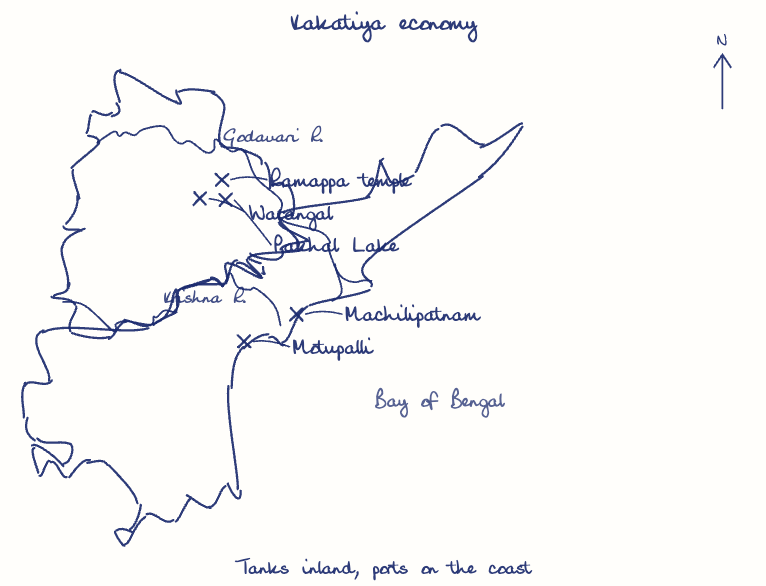
Under the Kakatiyas, Medieval Andhra Desha had a flexible caste order led by a Shudra-origin dynasty, the decentralised Nayankara system, and women rulers like Rudrama Devi. The economy rested on irrigation tanks like Pakala and Ramappa, land revenue and trade through ports like Motupalli protected by Ganapati Deva's Abhaya Sasanam.
Model answer
Ghissu Editorial · Verified 4 Oct 2026 · 239 words
Flexible Caste and Feudal System
Originating from Shudra varna, the Kakatiyas elevated warriors and merchants; the Nayankara system empowered local feudatories like Velamas and Reddis for governance.
Village Administration and Women’s Role
Villages were organized into Nadus and Sthalams with officials managing revenue; rulers like Rudrama Devi exemplified women’s political power, while Virasaivism improved Dalit status.
Irrigation and Agriculture1
Construction of tanks (Pakala, Ramappa) and canals ensured water supply, supporting a systematic land revenue system based on soil fertility.
Trade and Maritime Links
Ports such as Motupalli and Machilipatnam attracted Chinese, Sri Lankan, Arab and Persian merchants trading textiles and spices; Ganapati Deva’s Abhaya Sasanam safeguarded commerce.
Decentralized Monarchy
Nayankara system balanced central authority with local autonomy but led to later feudal tensions.
Infrastructure and Cultural Patronage
Irrigation and roads boosted agriculture and trade; coinage and temple patronage fostered economic stability and cultural growth.
Heritage and Water Management
Promote Kakatiya heritage and revive tank irrigation under Swarna Andhra Vision 20472 for agrarian sustainability.
Governance and Inclusion
Strengthen rural self-governance inspired by Nayankara and support social mobility through inclusive policies.
This model answer is indicative and the model can make mistakes; please verify key facts independently.
Practise this question
1Get the answer sheet
Sized for this question.
2Write your answer
Timed, by hand.
3Get it marked
Your score and what to fix.
This chapter in the exam
Andhra - Medieval16 questions
Asked in 8 of 8 sittings since 2008
Most tested: Telugu language and literature under medieval dynasties, especially Kakatiya, Qutub Shahi, Reddi, and Vijayanagara patronage.
- 2025Discuss the growth of various Saivite sects during the Kakatiya rule.
- 2025Discuss the significance of the Warangal Fort complex as a historical monument.
All 16 questions, sorted by sub-topic, with model answers and practice.
Question from the official APPSC Group-I Mains 2011 paper. Answer written by Ghissu's engine and checked against our editorial standards. Found an error? Tell us and we correct it within 48 hours.