Evaluate the contribution of Qutub Shahis to the Telugu language and literature.
In short
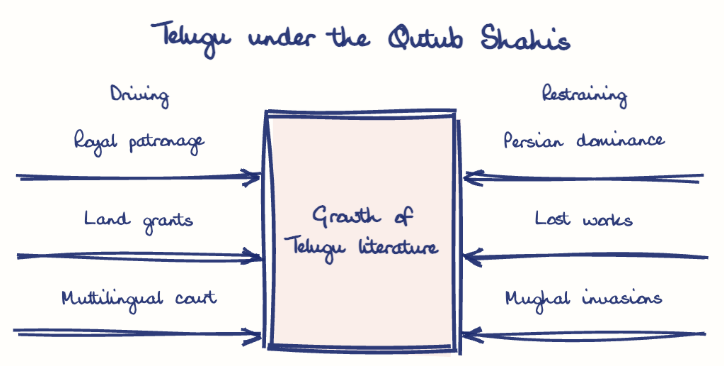
The Qutub Shahis made a genuine contribution to Telugu through royal patronage, honoured court poets and a multilingual environment, though Persian dominance, lost texts and Mughal conquest limited it. Ponnegenta Telaganaraya's Yayaticharitam, Kandukuri Rudrakavi's works and Kshetrayya of Movva, who composed over a thousand padas, flourished under them.
Model answer
Ghissu Editorial · Verified 4 Oct 2026 · 279 words
Royal Patronage of Telugu Poets
Ibrahim Quli Qutub Shah, influenced by Vijayanagara exile, patronized poets like Addanki Gangadhara Kavi and Kandukuri Rudrakavi with land grants and titles.
Creation of Telugu Literary Works
Notable works include Ponnegenta Telaganaraya’s 'Yayaticharitam' and Saranga Thammaiah’s 'Vaijayanthi Vilasam'; Kshetrayya from Movva village composed over 1000 'Padas'.
Integration in Court Culture
Telugu poets such as Ganesha Pandit served in courts; Kancharla Gopanna (Bhakta Ramadas) composed classical Keerthanas.
Multilingual Literary Environment
Telugu coexisted with Persian, Urdu, and Arabic, fostering cross-cultural literary innovation.
Religious and Cultural Differences
Muslim rulers balanced respect for Hindu traditions, limiting full cultural assimilation.
Loss of Literary Works
Many works, including Muhammad Quli Qutub Shah’s Telugu poetry, are lost, restricting full assessment.
Dominance of Persian and Urdu
Persian remained official; Urdu’s rise overshadowed Telugu in elite circles.
Geopolitical Instability
Mughal invasions disrupted patronage, especially in Krishna-Godavari delta.
Digital Preservation
Digitize Qutub Shahi Telugu manuscripts in Andhra Pradesh.
Educational Promotion
Include Qutub Shahi Telugu literature in curricula in Telangana and Andhra Pradesh.
Cultural Festivals
Organize literary festivals and awards in Hyderabad.
Support Multilingual Research
Encourage studies on Qutub Shahi multilingual literary interactions.
This model answer is indicative and the model can make mistakes; please verify key facts independently.
Practise this question
1Get the answer sheet
Sized for this question.
2Write your answer
Timed, by hand.
3Get it marked
Your score and what to fix.
This chapter in the exam
Andhra - Medieval16 questions
Asked in 8 of 8 sittings since 2008
Most tested: Telugu language and literature under medieval dynasties, especially Kakatiya, Qutub Shahi, Reddi, and Vijayanagara patronage.
- 2025Discuss the growth of various Saivite sects during the Kakatiya rule.
- 2025Discuss the significance of the Warangal Fort complex as a historical monument.
All 16 questions, sorted by sub-topic, with model answers and practice.
Question from the official APPSC Group-I Mains 2011 paper. Answer written by Ghissu's engine and checked against our editorial standards. Found an error? Tell us and we correct it within 48 hours.