Examine the factors responsible for the rise and growth of Jainism and Buddhism.
In short
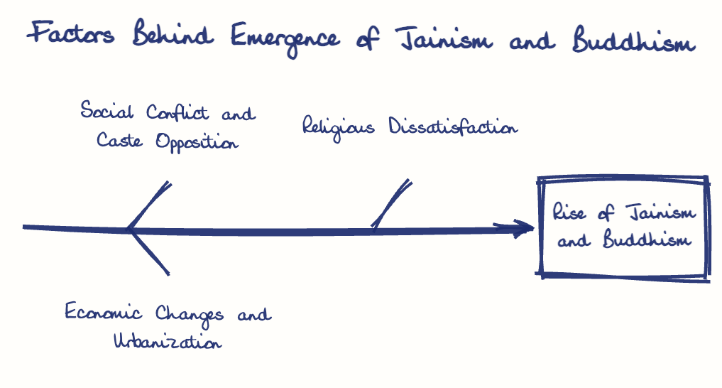
Jainism and Buddhism rose in the sixth century BCE as responses to varna oppression, ritual-bound Brahmanism and the needs of new mercantile classes created by urbanisation and trade. They grew through royal patronage, especially Ashoka's, inclusive membership, missionary zeal and preaching in popular languages like Pali and Ardhamagadhi.
Model answer
Ghissu Editorial · Verified 4 Oct 2026 · 286 words
Religious Dissatisfaction and Philosophical Innovation
The complex sacrificial rituals of Brahmanism faced criticism. Buddhism’s middle path (Madhyamarga) and denial of an eternal soul emphasized self-effort and optimism, while Jainism’s strict non-violence and karma doctrine offered disciplined ethical guidance, appealing to seekers of practical spirituality.
Royal Patronage and Institutional Support
Emperor Ashoka’s patronage enabled Buddhist missionary activities, construction of stupas, and councils that spread Buddhism across Asia. Jainism thrived under princely families’ support, sustaining peaceful coexistence and regional influence, especially in southern India.
Missionary Activities and Cultural Exchange
Buddhist monks actively propagated Dharma to Sri Lanka1, Southeast Asia, and Central Asia, aided by regional powers like the Andhras. Jainism’s influence spread regionally through teachers like Kondakundacharya, enriching Indian philosophical traditions.
Promote Interfaith Dialogue and Heritage Conservation
Reviving inclusive philosophies through dialogue and preserving sites like Amaravati and Sravana Belgola can enhance cultural awareness and tourism, strengthening India’s soft power.
This model answer is indicative and the model can make mistakes; please verify key facts independently.
Practise this question
1Get the answer sheet
Sized for this question.
2Write your answer
Timed, by hand.
3Get it marked
Your score and what to fix.
This chapter in the exam
Ancient India - Pre-history, IVC, Vedic, Mauryas, Kushans, Satavahanas, Sangam, Guptas16 questions
Asked in 8 of 8 sittings since 2008
Most tested: Harappan civilisation—urban planning, origin/decline, and continuity.
- 2025Discuss the origin and expansion of the Indus Valley Civilization.
- 2025Briefly analyze the teachings of Buddha and Mahavira.
All 16 questions, sorted by sub-topic, with model answers and practice.
Question from the official APPSC Group-I Mains 2011 paper. Answer written by Ghissu's engine and checked against our editorial standards. Found an error? Tell us and we correct it within 48 hours.