Trace the origin and growth of Adi-Andhra Movement in Modern Andhra Desha and examine the role of Gurram Jashuva and Boyi Bheemanna in the growth of Dalit consciousness.
In short
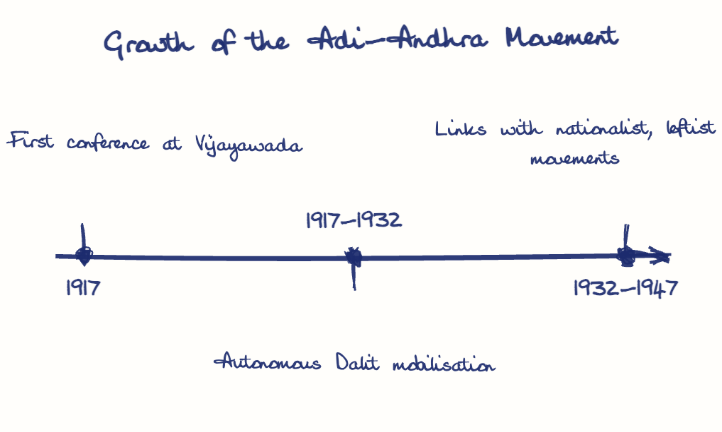
The Adi-Andhra Movement began with the first Adi-Andhra Conference at Vijayawada in 1917 under Bhagya Reddi Varma, uniting Dalits beyond Mala and Madiga labels to demand education, jobs and representation. Gurram Jashuva's Gabbilam and Boyi Bheemanna's Paleru and Gudiselu Kalipotunnayi gave this political awakening a literature of dignity.
Model answer
Ghissu Editorial · Verified 4 Oct 2026 · 276 words
Formation and Early Mobilization
Originating in 1917, influenced by reformist movements like Brahmo Samaj, leaders such as Bhagya Reddi Varma organized the first Adi-Andhra Conference in Vijayawada demanding political representation and social upliftment. Education was prioritized, with philanthropists like Vemuri Ramjee establishing schools and hostels in coastal Andhra.
Movement Phases and Political Context
The movement had two phases: autonomous Dalit mobilization (1917-1932) and engagement with nationalist and leftist politics (1932-1947). It unified Dalits under a common identity, rejecting sub-caste labels, but faced opposition from upper castes and limited coordination with parties in Andhra Pradesh1.
Literary Critique and Cultural Assertion
Jashuva’s poetry, including "Gabbilam," exposed caste discrimination and challenged Brahminical dominance, fostering Dalit pride and collective identity in Andhra Pradesh.
Highlighting Nationalist Contradictions
He critiqued the nationalist movement’s sidelining of Dalits, emphasizing that true freedom required caste annihilation.
Dalit Literary Voice
Bheemanna’s writings vividly portrayed Dalit struggles and aspirations, promoting social reform and identity2 in Andhra Pradesh.
Social Reform Advocacy
His work inspired Dalit empowerment and cultural renaissance alongside political mobilization.
This model answer is indicative and the model can make mistakes; please verify key facts independently.
Practise this question
1Get the answer sheet
Sized for this question.
2Write your answer
Timed, by hand.
3Get it marked
Your score and what to fix.
This chapter in the exam
Andhra - Nationalist Movement and Formation of the State22 questions
Asked in 8 of 8 sittings since 2008
Most tested: Formation of Andhra Pradesh and the Andhra-Telangana statehood process
- 2025What were the provisions of the Gentlemen's Agreement of 1956? How far could they satisfy apprehensions of the Telangana region?
- 2025Outline the role of the students in raising major issues in the 1969 Telangana agitation.
All 22 questions, sorted by sub-topic, with model answers and practice.
Question from the official APPSC Group-I Mains 2011 paper. Answer written by Ghissu's engine and checked against our editorial standards. Found an error? Tell us and we correct it within 48 hours.