Examine the classification of Scheduled Castes within the constitutional scheme.
In short
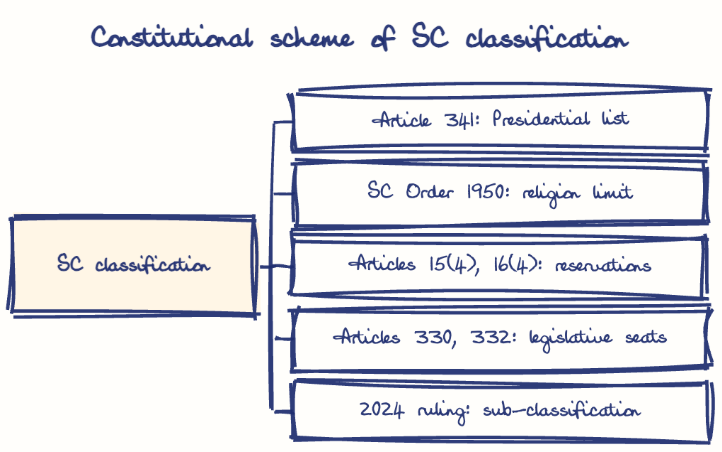
Under Article 341, the President notifies Scheduled Castes state by state, limited to Hindus, Sikhs and Buddhists, and they receive reservations under Articles 15(4), 16(4), 330 and 332. The Supreme Court's August 2024 ruling allowed states to sub-classify SCs, an idea Andhra Pradesh's 1996 Ramachandra Raju Commission had recommended.
Model answer
Ghissu Editorial · Verified 4 Oct 2026 · 322 words
Religious Restriction Clause
The 1950 Scheduled Castes Order restricts SC status to Hindu, Sikh, and Buddhist Dalits, excluding Dalits of other religions such as Christianity and Islam, thereby shaping the scope of constitutional benefits.
Sub-Classification and ‘Creamy Layer’ Concept
The Supreme Court’s 2024 verdict allows states to identify sub-groups within SCs, and several judges urged excluding economically advanced ‘creamy layer’ individuals from reservations, aiming at benefits reach the most disadvantaged.
State-Specific Lists and Presidential Approval
States propose caste lists based on socio-economic data and historical evidence, which require Presidential approval, maintaining constitutional oversight.
Andhra Pradesh Example
Andhra Pradesh’s 1996 Justice Ramachandra Raju Commission recommended sub-categorization of SCs by backwardness, illustrating state-level efforts to refine classification within the constitutional framework.
Data and Institutional Challenges
The lack of comprehensive caste-level socio-economic data, as seen in limited caste census availability, complicates objective classification and sub-categorization, affecting policy precision.
Addressing Internal Inequalities
Sub-classification prevents dominant sub-castes from monopolizing benefits, promoting social justice by targeting the most marginalized groups within SCs.
Risk of Community Fragmentation
Critics warn sub-classification may weaken SC political unity and social solidarity, potentially undermining collective empowerment efforts.
This model answer is indicative and the model can make mistakes; please verify key facts independently.
Practise this question
1Get the answer sheet
Sized for this question.
2Write your answer
Timed, by hand.
3Get it marked
Your score and what to fix.
This chapter in the exam
Indian Constitution, Fundamental Rights, DPSP and Union-State functions18 questions
Asked in 8 of 8 sittings since 2008
Most tested: Rights, social justice, and constitutional safeguards for disadvantaged groups.
- 2025The Indian Constitution favours a federal type of government. Considering this, what duties does the Constitution place on State Governments to ensure the smooth functioning of the nation?
- 2025The Constitution of India grants certain rights to citizens and also provides measures to safeguard them. What are the key constitutional arrangements to ensure the protection of these rights?
All 18 questions, sorted by sub-topic, with model answers and practice.
Question from the official APPSC Group-I Mains 2011 paper. Answer written by Ghissu's engine and checked against our editorial standards. Found an error? Tell us and we correct it within 48 hours.