Explain the conflict resolution mechanism in case of deadlock between the two houses of a State legislature on a piece of legislation.
In short
State legislatures have no joint sitting: under Article 197, if the Council rejects or delays a bill, the Assembly passes it again, and if the Council still fails to pass it within a month, it is deemed passed. Andhra Pradesh's 2020 decentralisation bills became law this way.
Model answer
Ghissu Editorial · Verified 4 Oct 2026 · 342 words
No Joint Sitting for States
Article 197 and related provisions exclude joint sittings for State legislatures, unlike Parliament’s bicameral conflict resolution under Article 108.
Assembly’s Override Power
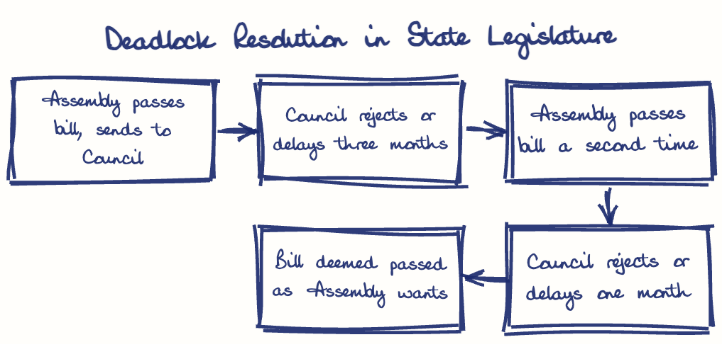
Article 197(2) allows the Assembly to pass a bill a second time if the Council rejects or amends it unacceptably; if the Council again rejects or delays beyond one month, the bill is deemed passed.
Council’s Time Limits
If the Council does not pass a bill within three months, the Assembly may pass it again, preventing indefinite deadlocks.
Money Bills Exception
The Council can only recommend amendments within 14 days, which the Assembly may accept or reject, ensuring no deadlock on financial legislation.
Bill Passage and Council Review
The Assembly passes the bill, sends it to the Council, which has three months to act; deadlock arises if rejected or amended unacceptably.
Second Assembly Passage and Final Council Action
The Assembly passes the bill again; the Council has one month to respond or the bill is deemed passed.
Governor’s Assent
After the bill is deemed passed, the Governor’s assent under Article 200 is mostly formal.
No Joint Sitting Authority
The Governor cannot summon a joint sitting; the Council’s role is limited to delay, not veto.
Practical Example
In Andhra Pradesh, the 2020 decentralisation and CRDA repeal bills were deemed passed after the Assembly passed them a second time, showing how this mechanism prevents legislative paralysis.
This model answer is indicative and the model can make mistakes; please verify key facts independently.
Practise this question
1Get the answer sheet
Sized for this question.
2Write your answer
Timed, by hand.
3Get it marked
Your score and what to fix.
This chapter in the exam
Parliament and State Legislatures13 questions
Asked in 8 of 8 sittings since 2008
Most tested: Comparative powers and status of the two Houses, especially Rajya Sabha vs Lok Sabha and Legislative Council vs Legislative Assembly.
- 2025In what aspects is the Legislative Council (Vidhan Parishad) different from the Rajya Sabha, considering its role at the state level?
- 2025What are the steps followed by the Indian Parliament in transforming a Bill into an Act?
All 13 questions, sorted by sub-topic, with model answers and practice.
Question from the official APPSC Group-I Mains 2011 paper. Answer written by Ghissu's engine and checked against our editorial standards. Found an error? Tell us and we correct it within 48 hours.