Explain the Constitutional guarantee to the Right to property in the light of the 44th Amendment Act.
In short
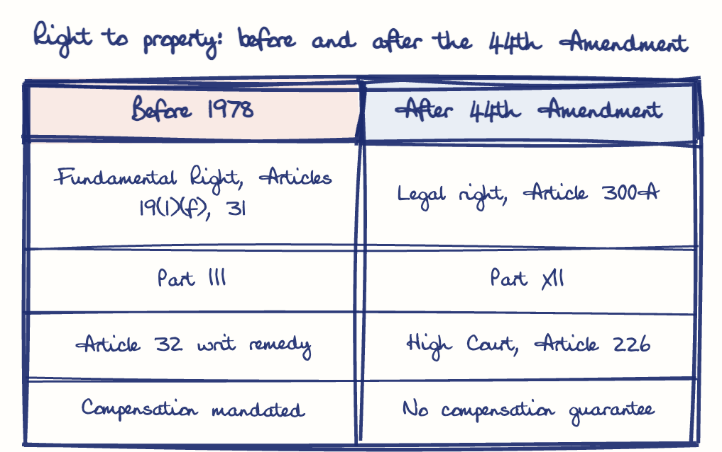
The 44th Amendment Act, 1978 removed the Right to Property from the Fundamental Rights by repealing Articles 19(1)(f) and 31, ending direct Supreme Court writ protection. It survives as a constitutional legal right under Article 300A, which bars deprivation of property except by authority of law, without guaranteed compensation.
Model answer
Ghissu Editorial · Verified 4 Oct 2026 · 280 words
Fundamental Right under Articles 19(1)(f) and 31
These articles guaranteed property rights with compensation and public purpose conditions, upheld by the Supreme Court in cases challenging zamindari abolition laws in Andhra Pradesh.
Parliamentary Amendments for Land Reforms
Amendments (1st, 4th, 17th, 25th, 39th, 40th, 42nd) introduced Articles 31A, 31B, and 31C to protect land reform laws from judicial invalidation, balancing individual rights and socio-economic reforms.
Removal from Fundamental Rights
The 44th Amendment repealed Articles 19(1)(f) and 31, ending Supreme Court writ jurisdiction over property rights.
Article 300A as Legal Right
Property rights became a constitutional but non-fundamental right under Article 300A, lacking guaranteed compensation and direct Supreme Court protection.
Facilitated Land Reforms
Downgrading the right eased state acquisition for public welfare projects like Polavaram irrigation in Andhra Pradesh.
Reduced Judicial Oversight
Supreme Court’s power to strike down property laws diminished, shifting balance to legislative supremacy.
Limited Protection
Article 300A protects against executive action but not legislative encroachments, risking property owner rights, especially in agrarian regions of Andhra Pradesh.
Strengthen Compensation Laws
Clear laws with judicial oversight are needed to ensure fair compensation and prevent arbitrary deprivation.
This model answer is indicative and the model can make mistakes; please verify key facts independently.
Practise this question
1Get the answer sheet
Sized for this question.
2Write your answer
Timed, by hand.
3Get it marked
Your score and what to fix.
This chapter in the exam
Indian Constitution, Fundamental Rights, DPSP and Union-State functions18 questions
Asked in 8 of 8 sittings since 2008
Most tested: Rights, social justice, and constitutional safeguards for disadvantaged groups.
- 2025The Indian Constitution favours a federal type of government. Considering this, what duties does the Constitution place on State Governments to ensure the smooth functioning of the nation?
- 2025The Constitution of India grants certain rights to citizens and also provides measures to safeguard them. What are the key constitutional arrangements to ensure the protection of these rights?
All 18 questions, sorted by sub-topic, with model answers and practice.
Question from the official APPSC Group-I Mains 2011 paper. Answer written by Ghissu's engine and checked against our editorial standards. Found an error? Tell us and we correct it within 48 hours.