The constitution postulates in its Preamble that India shall be a Secular Republic. What are the constitutional provisions consistent this declaration?
In short
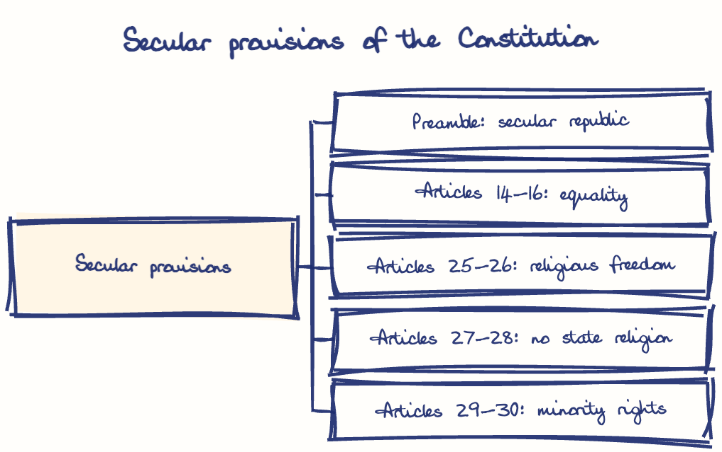
India's secular republic rests on equality and non-discrimination (Articles 14-16), freedom of religion (Articles 25-26), no state religious taxes or instruction (Articles 27-28), minority rights (Articles 29-30) and the duty to preserve composite culture (Article 51A(f)). The Bommai case (1994) made secularism part of the basic structure.
Model answer
Ghissu Editorial · Verified 4 Oct 2026 · 244 words
Preamble and Equality Articles
The Preamble (1976) declares India secular; Articles 14, 15, and 16 prohibit religious discrimination and ensure equality before law.
Articles 25-28 on Religious Freedom
These articles protect freedom of religion, allow religious management of affairs, and prevent state funding or religious instruction in state schools.
Minority Rights Protection
Articles 29 and 30 safeguard cultural and educational rights of minorities, enabling preservation of distinct identities.
Fundamental Duty
Article 51A(f) mandates citizens to preserve India’s composite culture, fostering mutual respect.
Basic Structure Doctrine
S.R. Bommai v. Union of India (1994) affirmed secularism as constitutional basic structure, barring religious favoritism.
State Reforms and Social Harmony
Indian secularism permits state intervention in religious reforms, e.g., Muslim Women (Protection of Rights on Marriage) Act, 2019.
State-Specific Challenges
In Andhra Pradesh, balancing minority rights and communal harmony remains a key challenge.
Promoting Interfaith Dialogue
Programs like Sarv Dharma Samvad foster tolerance among communities.
Uniform Civil Code
Article 44 encourages harmonizing personal laws to promote equality, though implementation is gradual.
Judicial Vigilance and Inclusive Policies
Strengthening courts and involving all communities in policymaking can uphold secularism’s spirit.
This model answer is indicative and the model can make mistakes; please verify key facts independently.
Practise this question
1Get the answer sheet
Sized for this question.
2Write your answer
Timed, by hand.
3Get it marked
Your score and what to fix.
This chapter in the exam
Indian Constitution, Fundamental Rights, DPSP and Union-State functions18 questions
Asked in 8 of 8 sittings since 2008
Most tested: Rights, social justice, and constitutional safeguards for disadvantaged groups.
- 2025The Indian Constitution favours a federal type of government. Considering this, what duties does the Constitution place on State Governments to ensure the smooth functioning of the nation?
- 2025The Constitution of India grants certain rights to citizens and also provides measures to safeguard them. What are the key constitutional arrangements to ensure the protection of these rights?
All 18 questions, sorted by sub-topic, with model answers and practice.
Question from the official APPSC Group-I Mains 2011 paper. Answer written by Ghissu's engine and checked against our editorial standards. Found an error? Tell us and we correct it within 48 hours.