Trace the genesis and development of Uniform Civil code in India. Cite authoritative judgments on this issue.
In short
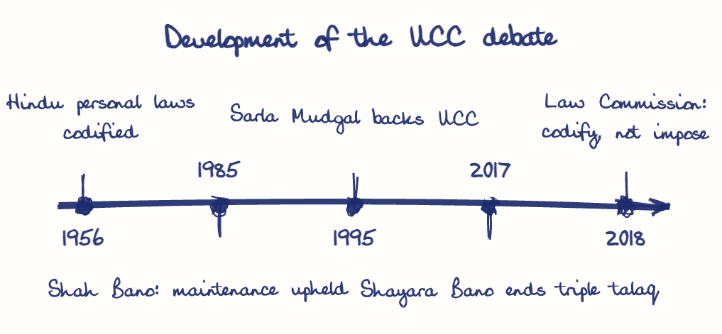
The Uniform Civil Code originates in Article 44, kept as a Directive Principle after Constituent Assembly debates, and developed through Hindu law codification in 1956, judicial calls and state laws like Uttarakhand's 2024 code. Authoritative judgments include Shah Bano (1985), Sarla Mudgal (1995) and Shayara Bano (2017).
Model answer
Ghissu Editorial · Verified 4 Oct 2026 · 276 words
Colonial Legacy and Early Codification
British-era personal laws entrenched pluralism to avoid communal unrest; Hindu personal laws were codified in 1956, including Sikhs, Jains, and Buddhists, while other communities retained distinct laws, complicating uniformity.
Judicial Milestones
The Shah Bano case (1985) upheld Muslim women’s maintenance rights under secular law, prompting the Muslim Women (Protection of Rights on Divorce) Act, 1986, which diluted the judgment but reignited UCC debate; the Shayara Bano case (2017) struck down triple talaq, reinforcing demands for UCC.
State-Level and Commission Efforts
Uttarakhand (2024) became the first state after independence to enact a UCC focusing on gender equality; Assam has moved in the same direction with a ban on polygamy; the 2018 Law Commission recommended gradual codification based on universal justice principles and fairness rather than abrupt reform.
Sarla Mudgal (1995)
The Supreme Court strongly advocated UCC to resolve conflicts in personal laws, especially regarding marriage and bigamy, and to protect women’s rights and legal consistency.
Phased Reform
Drawing lessons from Uttarakhand and Assam, reforms should be gradual, codifying personal laws with universal principles of justice and ensuring political will to overcome resistance.
This model answer is indicative and the model can make mistakes; please verify key facts independently.
Sources
Practise this question
1Get the answer sheet
Sized for this question.
2Write your answer
Timed, by hand.
3Get it marked
Your score and what to fix.
This chapter in the exam
Indian Constitution, Fundamental Rights, DPSP and Union-State functions18 questions
Asked in 8 of 8 sittings since 2008
Most tested: Rights, social justice, and constitutional safeguards for disadvantaged groups.
- 2025The Indian Constitution favours a federal type of government. Considering this, what duties does the Constitution place on State Governments to ensure the smooth functioning of the nation?
- 2025The Constitution of India grants certain rights to citizens and also provides measures to safeguard them. What are the key constitutional arrangements to ensure the protection of these rights?
All 18 questions, sorted by sub-topic, with model answers and practice.
Question from the official APPSC Group-I Mains 2011 paper. Answer written by Ghissu's engine and checked against our editorial standards. Found an error? Tell us and we correct it within 48 hours.