Critically Examine the procurement price policy of the Government of India and Andhra Pradesh.
In short
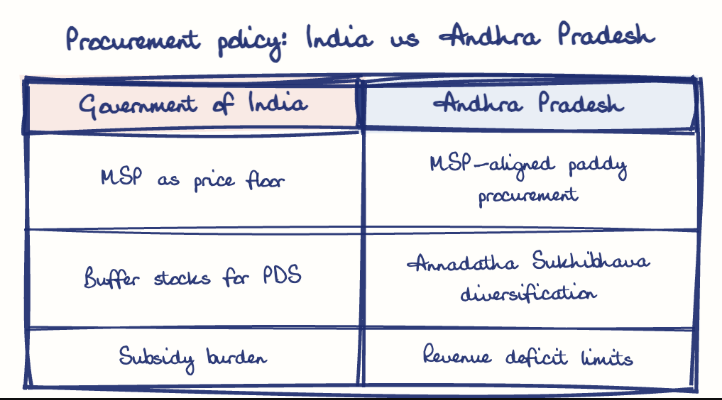
India's procurement price policy uses MSP as a price floor and builds buffer stocks for the PDS, and Andhra Pradesh applies it mainly to paddy, but coverage is narrow and delivery uneven. Few procurement centres in Rayalaseema, payment delays, storage losses and fiscal strain limit its benefit to small farmers.
Model answer
Ghissu Editorial · Verified 4 Oct 2026 · 280 words
MSP and Food Security
MSP guarantees minimum returns to farmers and supports buffer stocks for the Public Distribution System, ensuring availability and affordability of staples like rice and wheat.
Dual Pricing and Market Stabilization
The policy balances subsidies for vulnerable groups with market efficiency, preventing distress sales during bumper harvests and stabilizing prices amid supply shocks.
Procurement and Schemes
Andhra Pradesh uses MSP-aligned procurement primarily for paddy and staples, complemented by direct income support under Annadatha Sukhibhava and natural farming under APCNF to enhance farmer resilience.
Limited Crop Coverage
MSP focuses on a few major crops, limiting support for diversified and climate-resilient agriculture, which is crucial for regions like Andhra Pradesh facing ecological challenges.
Reach and Fiscal Issues
Thin procurement in drought-prone areas leaves vulnerable farmers without the price floor, while subsidy and procurement costs strain government finances, especially in Andhra Pradesh with its significant revenue deficit.
Expand Procurement
Broaden MSP coverage and procurement infrastructure to include pulses, oilseeds, and horticultural crops, particularly in marginalized and drought-prone regions of Andhra Pradesh.
Integrate with Sustainable Farming
Link procurement policies with initiatives like AP Community Managed Natural Farming to promote climate-resilient agriculture and long-term income security.
This model answer is indicative and the model can make mistakes; please verify key facts independently.
Practise this question
1Get the answer sheet
Sized for this question.
2Write your answer
Timed, by hand.
3Get it marked
Your score and what to fix.
This chapter in the exam
Agricultural Development (India)16 questions
Asked in 7 of 8 sittings since 2008
Most tested: Agricultural credit and market regulation/price policy.
- 2025Examine the significance of agriculture finance, production, and marketing in the context of India's agricultural development. Discuss the challenges and opportunities associated with financing agricultural activities, improving production, and developing efficient marketing systems to support sustainable growth in the agricultural sector.
- 2025Explain the role of the Agricultural Produce Market Committee (APMC) Act in Agricultural Price Policy in regulating the agricultural market in India. What are the issues that have been observed by policy makers regarding the functioning of the APMC Act?
All 16 questions, sorted by sub-topic, with model answers and practice.
Question from the official APPSC Group-I Mains 2011 paper. Answer written by Ghissu's engine and checked against our editorial standards. Found an error? Tell us and we correct it within 48 hours.