Discuss the composition of institutional and non-institutional credit in rural Andhra Pradesh.
In short
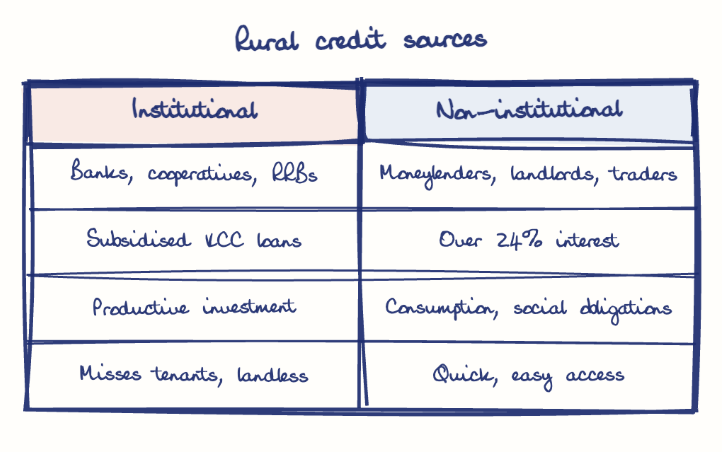
Rural credit in Andhra Pradesh is mainly institutional, led by commercial banks with cooperatives and RRBs, but moneylenders, landlords, traders and relatives still supply a large share to poorer households and tenants. Moneylender rates sometimes exceed 24% per annum, feeding debt traps and agrarian distress in regions like Rayalaseema.
Model answer
Ghissu Editorial · Verified 4 Oct 2026 · 242 words
Kisan Credit Card2 (KCC) Penetration
The KCC scheme has expanded collateral-free credit limits, enabling timely, subsidized loans for smallholders, enhancing agricultural input access. This has improved credit flow for short-term crop loans, reducing dependence on informal sources.
Moneylenders and Informal Credit
Non-institutional credit remains significant, with moneylenders charging rates often exceeding 24%, increasing indebtedness among small farmers and labourers. Informal lenders include landlords and traders, who fill gaps left by institutional credit.
Relative Share3 and Impact
Institutional credit accounts for over 57% of rural credit, supporting productive investments, while non-institutional credit finances consumption, trapping borrowers in debt cycles. Institutional credit promotes diversification and income growth, unlike informal credit.
Policy and Institutional Challenges
Limited institutional reach to tenant farmers and landless labourers, combined with cooperative sector weaknesses, necessitates targeted reforms and enhanced NABARD and government support. Strengthening branch penetration and simplifying procedures remain critical.
This model answer is indicative and the model can make mistakes; please verify key facts independently.
Practise this question
1Get the answer sheet
Sized for this question.
2Write your answer
Timed, by hand.
3Get it marked
Your score and what to fix.
This chapter in the exam
Agriculture Development in Andhra Pradesh31 questions
Asked in 8 of 8 sittings since 2008
Most tested: Agriculture’s structure, performance, and state policy interventions in Andhra Pradesh.
- 2025Discuss the role of agriculture in the economic development of Andhra Pradesh. How has agriculture contributed to the State Gross Domestic Product (SGDP) in recent years? Identify the key drivers influencing its performance.
- 2025What are the key drivers for the growth of the fisheries sector? What are the schemes undertaken by the fisheries department for the growth of this sector?
All 31 questions, sorted by sub-topic, with model answers and practice.
Question from the official APPSC Group-I Mains 2011 paper. Answer written by Ghissu's engine and checked against our editorial standards. Found an error? Tell us and we correct it within 48 hours.