Do you consider that land reforms in Andhra Pradesh have provided sufficient protection to tenants?
In short
Land reforms in Andhra Pradesh have not given tenants sufficient protection, because leases stay oral and unregistered, enforcement is weak and recent laws lean towards landowners. The 1956 Act's six-year leases and rent caps were rarely realised, and the 2019 Crop Cultivator Rights Act removed many tenant safeguards.
Model answer
Ghissu Editorial · Verified 4 Oct 2026 · 243 words
Historical Legislative Framework
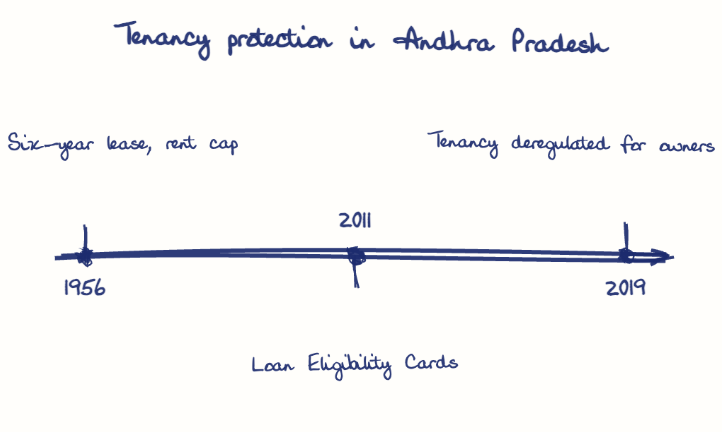
Key laws include the 1956 Act mandating six-year leases and rent caps, the 2011 Land Licensed Cultivators Act introducing Loan Eligibility Cards (LECs) to facilitate credit and subsidies, and the 2019 Crop Cultivator Rights Act, which replaced the 2011 Act and is criticised for prioritizing landowner rights.
Deregulation Impact
The 2019 Act’s owner-friendly approach raises concerns about tenant security, especially for Scheduled Castes who are a large tenant demographic, and could increase exploitation of vulnerable tenants.
Enforcement Gaps
Despite laws, most tenancy agreements remain unregistered, limiting tenant protections and benefits; weak enforcement and lack of awareness exacerbate vulnerabilities.
Caste and Tenancy
Scheduled Castes’ predominance among tenants highlights social inequities intertwined with land issues, demanding stronger protections to address historical marginalisation and economic exclusion.
Formalisation and Support
Mandatory lease registration, clearer tenant definitions excluding intermediaries, dedicated grievance redressal bodies, and targeted schemes for Scheduled Caste tenants are essential to safeguard tenant rights and improve access to benefits.
This model answer is indicative and the model can make mistakes; please verify key facts independently.
Practise this question
1Get the answer sheet
Sized for this question.
2Write your answer
Timed, by hand.
3Get it marked
Your score and what to fix.
This chapter in the exam
Agriculture Development in Andhra Pradesh31 questions
Asked in 8 of 8 sittings since 2008
Most tested: Agriculture’s structure, performance, and state policy interventions in Andhra Pradesh.
- 2025Discuss the role of agriculture in the economic development of Andhra Pradesh. How has agriculture contributed to the State Gross Domestic Product (SGDP) in recent years? Identify the key drivers influencing its performance.
- 2025What are the key drivers for the growth of the fisheries sector? What are the schemes undertaken by the fisheries department for the growth of this sector?
All 31 questions, sorted by sub-topic, with model answers and practice.
Question from the official APPSC Group-I Mains 2011 paper. Answer written by Ghissu's engine and checked against our editorial standards. Found an error? Tell us and we correct it within 48 hours.