Explain the significance of micro-finance institutions in meeting rural credit needs in Andhra Pradesh.
In short
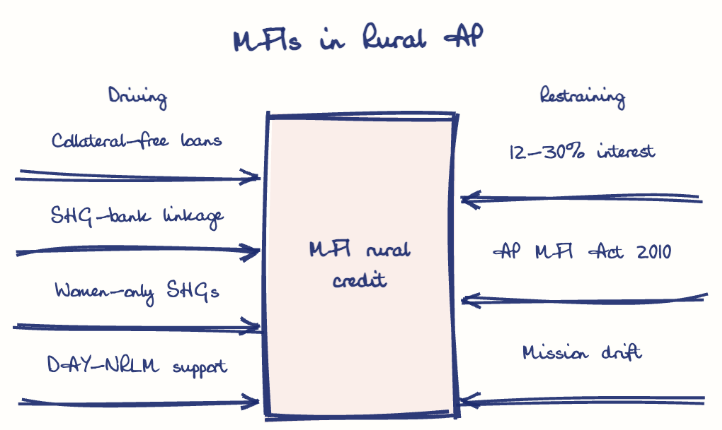
Micro-finance institutions meet rural credit needs in Andhra Pradesh by lending to collateral-poor households, empowering women and reducing reliance on moneylenders, though high interest and over-indebtedness pose risks. The state holds about 40% of bank-linked SHGs nationally, while the 2010 Microfinance Act disrupted credit flow.
Model answer
Ghissu Editorial · Verified 4 Oct 2026 · 270 words
SHG-Bank Linkage Model
Andhra Pradesh accounts for about 40% of SHGs linked to bank credit nationally, mobilizing millions of women into collective savings and credit groups. This model has been a cornerstone of rural financial inclusion, supported by government schemes like DAY-NRLM.
Women Empowerment
Over 90% of SHGs linked to banks are women-exclusive, fostering financial independence and social status. This has led to increased participation of women in micro-enterprises and decision-making at the household level.
Reducing Informal Borrowing
MFIs have reduced dependence on local moneylenders charging exorbitant interest, improving rural households’ financial health and reducing exploitation.
High Interest Rates and Regulation
MFIs charge 12-30% interest; the Andhra Pradesh Microfinance Institutions (Regulation of Money Lending) Act, 2010 caused many MFIs to exit, disrupting credit flow. This highlights the need for balanced regulation that protects borrowers without stifling credit availability.
Financial Literacy and Capacity Building
Limited borrower awareness hinders effective credit use; enhancing financial literacy and consumer protection is essential for sustainable impact.
This model answer is indicative and the model can make mistakes; please verify key facts independently.
Practise this question
1Get the answer sheet
Sized for this question.
2Write your answer
Timed, by hand.
3Get it marked
Your score and what to fix.
This chapter in the exam
Inclusive Growth: India and AP schemes49 questions
Asked in 8 of 8 sittings since 2008
Most tested: Women empowerment and poverty reduction through AP welfare and credit-linked institutions
- 2025Elaborate on the meaning of Inclusive Growth in the context of the Indian economy. Discuss the key strategies and instruments that can be employed to foster greater inclusion and ensure that the benefits of economic growth reach all sections of society.
- 2025Critically Examine the major poverty alleviation and employment generation programmes in India. How effective have they been in addressing rural and urban poverty?
All 49 questions, sorted by sub-topic, with model answers and practice.
Question from the official APPSC Group-I Mains 2011 paper. Answer written by Ghissu's engine and checked against our editorial standards. Found an error? Tell us and we correct it within 48 hours.