Highlight the important trends in incidence of poverty in Andhra Pradesh.
In short
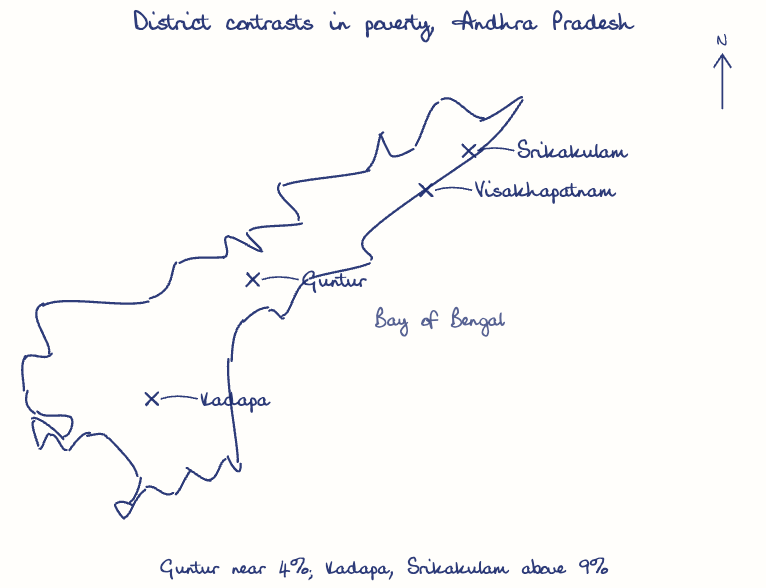
Poverty in Andhra Pradesh has declined sharply over three decades, driven by growth and welfare schemes, but remains uneven across districts and between rural and urban areas. The state's multidimensional poverty headcount is 15.37%, with Krishna and Guntur near 4% while YSR Kadapa and Srikakulam exceed 9%.
Model answer
Ghissu Editorial · Verified 4 Oct 2026 · 264 words
Significant Poverty Reduction
Poverty rates have declined steadily, aided by schemes like Samagra Shiksha Abhiyan3 and Janani Suraksha Yojana, improving multidimensional poverty indices. The Multidimensional Poverty Index (MPI) headcount ratio stands at 15.37%, showing progress in health, education, and living standards.
Economic Growth and Sectoral Shifts
Andhra Pradesh’s GSDP growth, notably 10.7%4 in agriculture for 2024-25, and industrial hubs like Visakhapatnam have raised incomes, though urban informal employment sustains poverty pockets. The rise in urban population and industrial corridors has created new opportunities but also challenges in urban poverty management.
Health and Governance Issues
The Andhra Pradesh Health Infrastructure5: Key Gaps and Human Resource Shortfalls (CAG 2024) reveals 22% vacancy in secondary healthcare posts; Andhra Pradesh CAG Audit reports welfare fund diversion affecting scheme efficacy. Underfunding of health (3.11% of budget vs. 8% target) further constrains human development and poverty alleviation.
Inclusive Growth and Inequality
Rising per capita income (₹2,68,653 in 2024-25) offers growth potential, but persistent regional and social inequalities require targeted policies. Marginalized groups like Scheduled Castes and Tribes need focused interventions to ensure equitable benefits.
This model answer is indicative and the model can make mistakes; please verify key facts independently.
Practise this question
1Get the answer sheet
Sized for this question.
2Write your answer
Timed, by hand.
3Get it marked
Your score and what to fix.
This chapter in the exam
Inclusive Growth: India and AP schemes49 questions
Asked in 8 of 8 sittings since 2008
Most tested: Women empowerment and poverty reduction through AP welfare and credit-linked institutions
- 2025Elaborate on the meaning of Inclusive Growth in the context of the Indian economy. Discuss the key strategies and instruments that can be employed to foster greater inclusion and ensure that the benefits of economic growth reach all sections of society.
- 2025Critically Examine the major poverty alleviation and employment generation programmes in India. How effective have they been in addressing rural and urban poverty?
All 49 questions, sorted by sub-topic, with model answers and practice.
Question from the official APPSC Group-I Mains 2011 paper. Answer written by Ghissu's engine and checked against our editorial standards. Found an error? Tell us and we correct it within 48 hours.