What are the causes for inter-regional and inter-district disparities in Andhra Pradesh?
In short
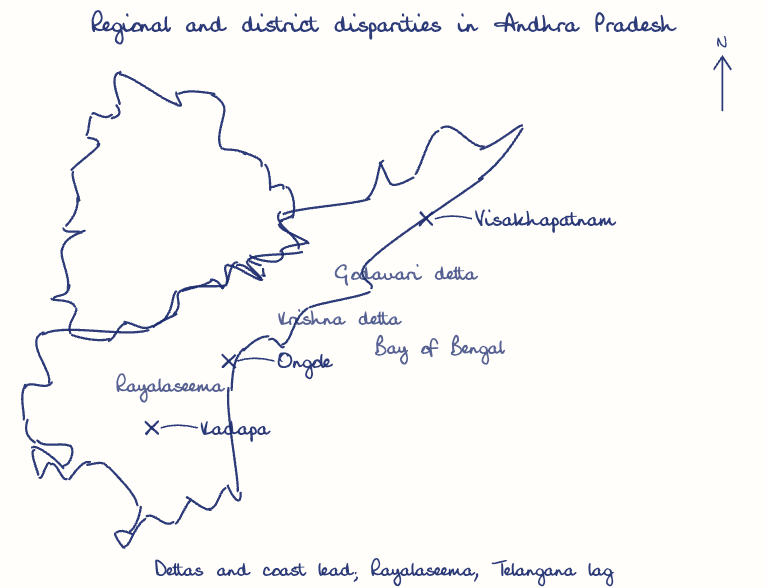
Disparities across Telangana, Coastal Andhra and Rayalaseema and among districts arise from differing natural resources and irrigation, concentrated infrastructure and industry, historical administrative neglect, uneven social development and weak governance. Drought-prone Rayalaseema lags the fertile Krishna-Godavari delta, while districts like Krishna attract far more investment than YSR and Prakasam.
Model answer
Ghissu Editorial · Verified 4 Oct 2026 · 254 words
Geographical and Environmental Constraints
The three regions (Telangana, Coastal Andhra, and Rayalaseema) differ in natural resources and climate; drought-prone Rayalaseema lags behind fertile Coastal Andhra’s Krishna-Godavari delta, limiting agricultural productivity and income.
Social Development Gaps
Coastal Andhra shows better literacy and health indicators than Rayalaseema, where shortages in healthcare and education persist. The Andhra Pradesh Health Infrastructure2 report (CAG 2024) highlights significant vacancies and inadequate facilities in backward regions, worsening disparities.
Unequal Resource Allocation and Fiscal Capacity
Districts like Krishna with dense populations and economic activity receive more fiscal resources and investments, while YSR and Prakasam with weaker economies face underinvestment, limiting development prospects.
Governance and Welfare Scheme Lapses
The CAG audit of Andhra Pradesh welfare schemes reveals fund diversion and implementation failures, disproportionately impacting backward districts and widening social and economic gaps.
Targeted Infrastructure and Social Spending3
Prioritise transport, irrigation, and health infrastructure in lagging districts, addressing vacancies and deficits highlighted by the Andhra Pradesh Health Infrastructure report (CAG 2024) to improve productivity and wellbeing.
Strengthen Local Governance
Empower local bodies for better scheme implementation and resource use, ensuring accountability and supporting Swarna Andhra Vision 2047’s balanced growth goals.
This model answer is indicative and the model can make mistakes; please verify key facts independently.
Practise this question
1Get the answer sheet
Sized for this question.
2Write your answer
Timed, by hand.
3Get it marked
Your score and what to fix.
This chapter in the exam
Inclusive Growth: India and AP schemes49 questions
Asked in 8 of 8 sittings since 2008
Most tested: Women empowerment and poverty reduction through AP welfare and credit-linked institutions
- 2025Elaborate on the meaning of Inclusive Growth in the context of the Indian economy. Discuss the key strategies and instruments that can be employed to foster greater inclusion and ensure that the benefits of economic growth reach all sections of society.
- 2025Critically Examine the major poverty alleviation and employment generation programmes in India. How effective have they been in addressing rural and urban poverty?
All 49 questions, sorted by sub-topic, with model answers and practice.
Question from the official APPSC Group-I Mains 2011 paper. Answer written by Ghissu's engine and checked against our editorial standards. Found an error? Tell us and we correct it within 48 hours.