Deliberate on (i) Wind power in India (ii) Biomass management in India (iii) Ocean energy
In short
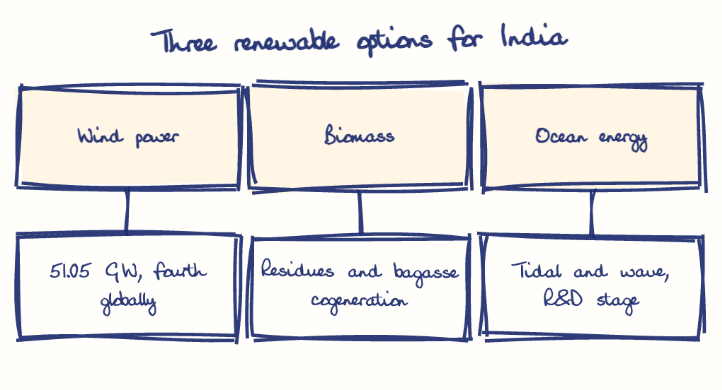
Wind power is a mature sector moving offshore with 51.05 GW installed by June 2025 and a 30 GW offshore target, while biomass management turns crop residues into energy despite collection gaps. Ocean energy is still at the R&D stage, though Andhra Pradesh's 974 km coastline offers potential.
Model answer
Ghissu Editorial · Verified 4 Oct 2026 · 268 words
Robust Capacity and Manufacturing
India ranks fourth globally with 51.05 GW wind capacity (2025), up from 21.04 GW in 2014, supported by a manufacturing base producing 10,000 MW annually.
Offshore Wind and Policy Support
The 7,500 km coastline offers 30 GW offshore wind potential by 2030, with partnerships with Denmark and the UK addressing infrastructure and regulatory challenges. Andhra Pradesh’s coastline and ports like Visakhapatnam provide strategic offshore wind opportunities.
Significant Renewable Contribution
Biomass targets 10,000 MW capacity by 2022, aided by financial support for grid-interactive power and bagasse cogeneration, aligning with Swachh Bharat Mission4’s waste-to-energy initiatives.
Supply Chain and Regional Potential
Challenges include seasonal feedstock and inefficient tech; Andhra Pradesh’s agrarian economy offers biomass from crop residues and aquaculture waste but needs better collection and processing infrastructure.
Emerging Sector with Legal Framework
Ocean energy is in R&D due to costs and site limitations; Article 297 and the Territorial Waters Act govern seabed resources, requiring central-state coordination.
Biomass Technology Investment
Support R&D and logistics improvements for efficient biomass utilization and year-round feedstock availability.
This model answer is indicative and the model can make mistakes; please verify key facts independently.
Practise this question
1Get the answer sheet
Sized for this question.
2Write your answer
Timed, by hand.
3Get it marked
Your score and what to fix.
This chapter in the exam
Energy: needs, resources, policy; Nuclear programme and policy24 questions
Asked in 8 of 8 sittings since 2008
Most tested: Renewable energy transition in India, especially solar/clean energy and barriers to large-scale adoption.
- 2025Differentiate between conventional and non-conventional energy resources. Explain their relevance in India's energy sector.
- 2023What is the current scenario of renewable power generation in India ? Discuss the factors responsible for the growing focus and shift towards Renewable energy.
All 24 questions, sorted by sub-topic, with model answers and practice.
Question from the official APPSC Group-I Mains 2011 paper. Answer written by Ghissu's engine and checked against our editorial standards. Found an error? Tell us and we correct it within 48 hours.