Describe the causative agent for malaria, emphasize its life cycle in different hosts and discuss the preventive measures for the disease.
In short
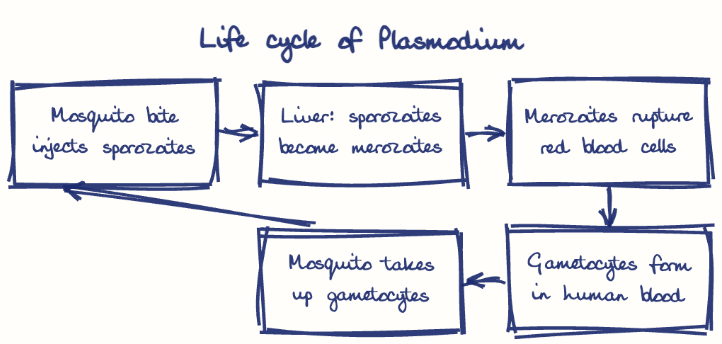
Malaria is caused by Plasmodium parasites, chiefly falciparum and vivax, whose sporozoites, injected by female Anopheles mosquitoes, multiply in the human liver and red blood cells, while gametocytes develop in the mosquito. Prevention relies on treated bed nets, indoor spraying, removing breeding sites, early diagnosis and vaccines.
Model answer
Ghissu Editorial · Verified 4 Oct 2026 · 244 words
Malaria, caused by Plasmodium parasites, is a persistent public health challenge in tropical regions like Andhra Pradesh. India has reduced malaria cases by 69% and deaths by 68% between 2017 and 2023, aiming for elimination by 2030.
Parasite Biology and Control Framework
1. Causative Agent and Life Cycle: Plasmodium falciparum and P. vivax require humans and female Anopheles mosquitoes to complete their life cycle, involving sporozoites entering the liver, merozoites infecting red blood cells, and gametocytes continuing the cycle in mosquitoes.
2. National Strategic Initiatives: The Intensified Malaria Elimination Project (IMEP)-31 and Test, Treat, Track strategy underpin India’s National Strategic Plan (2023-27), enhancing surveillance, diagnosis, and treatment, including in Andhra Pradesh.
Environmental and Drug Resistance Issues
Stagnant water in coastal and canal areas of Andhra Pradesh complicates vector control; drug-resistant Plasmodium strains require updated treatment protocols.
Community Engagement and Progress
Socioeconomic factors limit preventive uptake; however, India exited the WHO High Burden to High Impact group in 2024, with 122 districts reporting zero cases, including targeted efforts in Andhra Pradesh.
Vector Control and Vaccination
Use of insecticide-treated nets, indoor residual spraying, and WHO-approved vaccines like RTS,S/AS01 are key preventive tools.
Surveillance and Awareness
The Test, Treat, Track strategy and tailored education campaigns promote early diagnosis and behavioural change in vulnerable populations.
This model answer is indicative and the model can make mistakes; please verify key facts independently.
Sources
Practise this question
1Get the answer sheet
Sized for this question.
2Write your answer
Timed, by hand.
3Get it marked
Your score and what to fix.
This chapter in the exam
Human diseases; genetic engineering basics; biotechnology in agriculture; vaccines54 questions
Asked in 8 of 8 sittings since 2008
Most tested: Vaccines and immunisation, alongside GM crops/biotech agriculture.
- 2025Discuss the transmission dynamics of respiratory tract infections in densely populated urban settings. Propose effective public health strategies for their prevention.
- 2025Examine how urban infrastructure influences the implementation of preventive measures during microbial disease outbreaks. Suggest technology-driven solutions.
All 54 questions, sorted by sub-topic, with model answers and practice.
Question from the official APPSC Group-I Mains 2011 paper. Answer written by Ghissu's engine and checked against our editorial standards. Found an error? Tell us and we correct it within 48 hours.